
Signals
Observations on trust, work and the systems changing underneath them.
Trust Should Be Able to Withstand a Question
There's an interesting difference between information we believe and information we're willing to question.
We tend to think trust is strongest when there are no doubts.
When the record is clean.
When the references are positive.
When everyone agrees.
When the evidence points in one direction.
But I've come to believe something slightly different.
The strongest trust may not come from evidence that goes unquestioned. It may come from evidence that can withstand being questioned.
That's an important distinction.
Especially when the information we're relying on can influence someone's livelihood, a company's opportunities, or a decision involving real financial and operational risk.
Every Record Begins With a Perspective
Consider something that happens every day in transportation.
A delivery goes wrong.
The freight arrives late.
The customer is frustrated.
The broker receives a complaint.
The carrier believes the delay was unavoidable.
The driver remembers spending four hours waiting at the previous facility.
Everyone experienced the same event.
But they didn't necessarily experience the same reality.
The customer knows the delivery missed its appointment.
The broker knows a commitment wasn't fulfilled.
The carrier knows the schedule was disrupted.
The driver knows what happened along the way.
Each perspective may contain legitimate information.
And none, by itself, necessarily tells the complete story.
This is one of the challenges with professional reputation.
We often preserve someone's conclusion without preserving enough of the circumstances that produced it.
And once that conclusion becomes part of a permanent record, something subtle happens.
An observation begins looking like an established fact.
An Observation Isn't Always a Verdict
Think about how easily information can change as it moves through an organization.
Someone reports that a driver was difficult.
Another person records a service failure.
A manager makes a note.
A customer assigns a negative rating.
Over time, those individual observations can become shorthand for someone's professional identity.
Unreliable.
Uncooperative.
Difficult.
High risk.
Sometimes those conclusions are justified.
Sometimes they're not.
And sometimes they were reasonable interpretations of an event but incomplete descriptions of the person or organization involved.
The challenge isn't that people make judgments.
They have to.
The challenge is that judgments can become detached from the evidence that originally supported them.
Eventually, we may remember what someone thought without remembering why they thought it.
That's a fragile foundation for trust.
Credibility Requires More Than Confirmation
We've talked before about the importance of independent evidence.
When multiple credible sources repeatedly observe the same behavior, confidence can increase.
That remains true.
But there's another side to the equation.
What happens when credible sources disagree?
Suppose a carrier has an excellent service history across hundreds of transactions.
Then one customer reports a serious failure.
Should the complaint disappear because the broader history is positive?
Of course not.
Should the entire history become irrelevant because of one complaint?
Probably not.
The more useful question is whether we can understand what happened.
Was the complaint supported by operational records?
Was there a documented equipment failure?
Did the carrier communicate appropriately?
Was the problem resolved?
Did similar incidents happen again?
Was the customer given an opportunity to describe the experience accurately?
Was the carrier given an opportunity to respond?
These questions aren't obstacles to credibility.
They're part of what creates it.
Evidence becomes more trustworthy when it can be examined, challenged, and placed in context.
Fairness Isn't the Opposite of Accountability
Sometimes we treat fairness and accountability as competing priorities.
If we allow someone to challenge a negative record, perhaps we're weakening accountability.
If we preserve every negative observation, perhaps we're being more objective.
Neither assumption is necessarily correct.
A credible system shouldn't allow someone to erase legitimate evidence simply because they dislike it.
But it also shouldn't allow an inaccurate or misleading claim to become permanent truth simply because someone entered it first.
There's a meaningful difference between correcting a record and rewriting history.
One strengthens credibility.
The other undermines it.
Imagine a professional history in which the underlying evidence remains intact, but disputed information can be identified, supporting documentation considered, and corrections made transparently.
A record could acknowledge disagreement without pretending the disagreement never happened.
A mistake could remain visible alongside the actions taken to address it.
An allegation could be distinguished from a verified event.
And a professional could continue building a history without being permanently defined by someone else's interpretation of a single experience.
That's not an argument for making reputation less accountable.
It's an argument for making accountability more accurate.
The Right to Question Matters to Everyone
This isn't simply about protecting individuals from unfair criticism.
Organizations have just as much at stake.
A shipper needs to know whether a carrier has a history of preventable failures.
A broker needs to understand whether a service provider consistently follows through.
A carrier needs to know whether a prospective partner honors its commitments.
An employer needs credible information when evaluating responsibility and risk.
Those decisions can have significant consequences.
And decision-makers shouldn't have to choose between accepting a questionable conclusion and ignoring the record entirely.
They should be able to examine the evidence.
Understand its origins.
Recognize its limitations.
Consider competing explanations.
And reach their own conclusions.
That requires something more sophisticated than a collection of ratings.
It requires information that remains connected to its source and meaning.
A System That Cannot Be Corrected Eventually Becomes Less Trustworthy
Every system built by people will eventually contain mistakes.
Incorrect information.
Incomplete information.
Outdated information.
Misunderstood circumstances.
Even deliberately misleading claims.
No amount of technology eliminates that possibility.
And the more consequential a system becomes, the more important those limitations become.
A small error in an internal note may have little effect.
The same error, repeated across organizations and interpreted as verified professional history, could have much larger consequences.
This creates a responsibility that grows alongside the usefulness of shared information.
If evidence is going to travel, the ability to understand and correct it matters too.
Otherwise, we're simply making imperfect judgments more portable.
And portability, by itself, doesn't make something true.
Trust Is Stronger When the Process Is Visible
Perhaps this is one of the more overlooked qualities of trustworthy infrastructure.
It shouldn't simply preserve what people said.
It should help us understand why the information deserves consideration.
Who observed the event?
What supports the observation?
What remains uncertain?
Was the information challenged?
Was a correction made?
What happened afterward?
These details may not always produce a simple answer.
But they can produce something more valuable.
A reasoned answer.
One that a decision-maker can examine rather than merely accept.
And one that a person or organization affected by the information can understand rather than simply endure.
The goal isn't to create a world in which everyone agrees about everyone else.
That would be unrealistic.
The goal is to make disagreement less destructive to the truth.
The Difference Between Being Trusted and Being Beyond Question
We often associate trust with unquestioned acceptance.
But consider the relationships we trust most.
They're rarely relationships in which questions are forbidden.
They're relationships in which questions can be asked.
Concerns can be raised.
Mistakes can be acknowledged.
Explanations can be considered.
And confidence can survive the process.
Professional reputation shouldn't operate by an entirely different principle.
As more of our working histories become visible, connected, and useful beyond the organizations where they originated, we should be thoughtful about what makes those histories credible.
Not just the quantity of information.
Not just the number of sources.
Not just how consistently the evidence points in one direction.
But whether the underlying record is capable of standing up to reasonable examination.
Because the purpose of preserving professional history isn't to create an unquestionable story about someone.
It's to create a more reliable foundation for understanding what they've demonstrated.
Trust isn't weakened by the ability to ask questions.
It's strengthened when the answers can withstand them.

The Best Evidence Is Created While the Work Is Being Done
Most businesses spend a remarkable amount of time trying to prove things that have already happened.
A driver completes a delivery.
A carrier fulfills a commitment.
A dispatcher solves a problem.
A customer experiences exceptional service.
A manager makes a difficult decision that prevents a much larger problem.
The work happens.
People experience it.
Someone learns something valuable.
And then, surprisingly often, that knowledge becomes difficult to find.
Later, when someone needs to establish trust, we begin trying to reconstruct what was already known.
We ask for references.
Request documentation.
Collect recommendations.
Verify employment.
Make phone calls.
Search through records.
We create an entirely new process to prove something that the original work may have already demonstrated.
What if the evidence didn't have to be reconstructed afterward?
The Work Already Creates the Signals
Think about how much information an ordinary freight movement generates.
A load is accepted.
An appointment is scheduled.
Equipment is inspected.
A driver communicates with dispatch.
A pickup is completed.
A delivery is made.
An exception is handled.
A customer receives what was promised.
Each interaction creates information.
Some of it is transactional.
Some operational.
Some administrative.
But embedded in those interactions are observations about performance.
Was the commitment honored?
Was communication timely?
Were problems addressed responsibly?
Did the people involved do what they said they would do?
Was the outcome consistent with previous experiences?
These aren't hypothetical questions.
They're questions people already answer, often without realizing they're doing it.
The information exists because the work happened.
The problem is that much of its meaning doesn't survive the transaction.
We Often Separate Proof From Performance
There's something inefficient about the way we establish professional credibility.
First, someone does the work.
Then, sometime later, we ask them to prove they did the work well.
Those become two different activities.
Performance happens inside operations.
Proof happens inside applications, references, reviews, and verification processes.
The separation creates unnecessary work.
It also creates opportunities for information to become incomplete.
People forget.
Employees leave.
Systems change.
Relationships end.
Records become inaccessible.
Context disappears.
Eventually, we're left with a description of someone's experience rather than much of the evidence that experience produced.
And the longer we wait to reconstruct that history, the harder it becomes.
The distance between performance and proof is where valuable context gets lost.
What If Evidence Were a Byproduct?
Consider the difference between asking someone to create a reputation and allowing their reputation to develop through ordinary work.
The first requires additional effort.
Complete another profile.
Request another endorsement.
Solicit another review.
Maintain another account.
Convince another person.
The second begins with something people are already doing.
Working.
Making commitments.
Communicating.
Solving problems.
Building relationships.
Demonstrating competence.
The opportunity isn't to turn every interaction into a rating or require everyone to document every good deed.
That would create another layer of administrative work.
And it might actually make the underlying problem worse.
The more interesting possibility is that meaningful evidence could emerge naturally from existing operational activity.
With appropriate verification.
With context.
With responsible permissions.
And with enough continuity that the value of the information doesn't disappear when the transaction ends.
No new performance needs to be invented.
No artificial behavior needs to be encouraged.
The work itself remains the source.
The Difference Between Collecting Information and Preserving Meaning
Of course, recording an activity doesn't automatically create useful evidence.
A timestamp may establish that something happened.
It doesn't necessarily explain the circumstances.
A completed delivery doesn't tell us everything about the driver's professionalism.
A customer complaint doesn't tell us everything about the carrier.
And a successful transaction doesn't prove that every participant performed exceptionally.
That distinction matters.
A useful system would need to preserve more than isolated events.
It would need to recognize which observations are meaningful, where they originated, and how they relate to a broader history.
Sometimes the most important information isn't that a delivery was late.
It's that the driver identified a problem early, communicated clearly, helped coordinate a solution, and protected the customer from a much larger disruption.
The operational record might say late.
The professional evidence might tell a more complete story.
Neither should be manufactured.
Both should remain connected to what actually occurred.
Better Infrastructure Shouldn't Create More Work
This is where the idea becomes particularly interesting.
Many technologies promise better decisions by asking people to contribute more information.
More forms.
More reviews.
More updates.
More documentation.
More activity inside another platform.
Sometimes that's necessary.
But the strongest infrastructure often works differently.
It becomes useful because it fits naturally into what people are already doing.
Think about the difference between a system that requires people to continually explain their professional value and one that responsibly preserves credible evidence as that value is demonstrated.
One creates an additional task.
The other allows existing activity to create an additional benefit.
For individuals, that could mean less time repeatedly establishing credibility.
For companies, it could mean better context when evaluating unfamiliar relationships.
For an industry, it could mean that ordinary transactions gradually contribute to a deeper understanding of demonstrated performance.
Not because everyone stopped working to build a reputation.
Because the work was already building one.
The Most Valuable Evidence May Be the Least Demanding to Create
Transportation operates through an extraordinary number of relationships.
Drivers and carriers.
Brokers and shippers.
Dispatchers and customers.
Facilities and service providers.
People who may work together once.
People who may work together for decades.
Every day, those relationships generate experiences that influence future decisions.
Some experiences are memorable.
Most are ordinary.
But ordinary doesn't mean unimportant.
Reliability is often ordinary.
Professionalism is often ordinary.
Consistency is almost always ordinary.
And those are precisely the characteristics that become most valuable when demonstrated repeatedly over time.
Imagine if more of that history could accumulate without requiring everyone involved to continually stop and describe it.
If useful evidence could be preserved near the moment it was created.
If its context could remain attached.
If credible observations could reinforce one another.
And if the people and organizations responsible for that performance could benefit from what their work had already demonstrated.
The result wouldn't simply be more information.
It could be less duplicated effort.
Less forgotten experience.
Less dependence on carefully constructed claims.
And a better foundation for the next relationship.
There's an important principle underneath all of this.
The purpose of trust infrastructure shouldn't be to make people work harder to prove themselves.
It should make the work they've already done harder to overlook.
Because the best evidence may not be something we ask people to create.
It may be something we finally learn how to preserve.

The Best Evidence Is Often Left Behind
Most reputation systems ask people to create reputation.
Rate the experience.
Leave a review.
Write a recommendation.
Complete a survey.
Give someone five stars.
We've become so accustomed to this that it seems almost inevitable.
If we want to understand someone's reputation, we ask other people what they think of them.
But there may be another source of evidence hiding in plain sight.
The work itself.
Work Leaves Traces
Think about what happens during an ordinary day in transportation.
A load is accepted.
An appointment is kept.
A problem occurs.
Someone communicates it.
A commitment is made.
Someone follows through.
Equipment is maintained.
Documents are completed.
A customer is updated.
An exception gets resolved.
A shipment arrives.
None of these activities exists primarily to build a reputation.
They're simply the work.
But each interaction leaves something behind.
A small piece of evidence about what happened.
Over time, those pieces can begin to tell a story.
That's Different From Asking for an Opinion
Suppose I ask someone:
Is Kurt reliable?
I've asked for a judgment.
That judgment may be thoughtful.
It may be accurate.
It may also be influenced by memory, personality, one particularly good experience, one particularly bad experience, or the relationship between the two people.
Now imagine asking a different set of questions.
Did he do what he said he would do?
Did he communicate when circumstances changed?
Did other people experience the same thing?
Was it repeated?
What happened when something went wrong?
Did the pattern continue over time?
Those questions are different.
They're less about someone's opinion of the person.
They're more about what actually occurred.
Reputation becomes more credible when it emerges from behavior rather than being manufactured through commentary.
We May Be Asking People to Create Data That Already Exists
This happens constantly.
A transaction takes place.
The system records dozens of details about it.
Then, at the end, we ask:
How was your experience?
There's nothing inherently wrong with that.
Sometimes subjective experience is exactly what matters.
But it is worth noticing the sequence.
We observed the actual interaction.
Then we asked someone to summarize the interaction with stars.
In some situations, the summary may be less informative than the evidence the interaction already produced.
Did the person show up?
Did they follow through?
Did the commitment change?
Was the issue resolved?
Did both sides participate?
Was this consistent with previous experiences?
The work may already contain much of what we're trying to learn.
The Strongest Systems May Require Less Reputation-Building
Imagine if every credit-card transaction required the merchant and customer to rate each other's payment reliability.
It would be exhausting.
More importantly, it would be unnecessary.
The transaction itself creates evidence.
Payment happened.
Or it didn't.
The network remembers.
Over time, useful history emerges from ordinary participation in the system.
The participants don't have to stop and manufacture the history.
They create it by doing the thing they came there to do.
That principle becomes interesting when applied to professional reputation.
What if building a credible professional history required less additional behavior?
No campaign for reviews.
No collecting endorsements.
No carefully curated profile.
No asking everyone you've worked with to publicly validate you.
You work.
You interact.
You fulfill commitments.
You solve problems.
You accumulate experience.
And legitimate evidence of those experiences gradually accumulates with you.
That Could Change Who Gets Recognized
There's another reason this matters.
Some people are very good at managing their reputations.
Others are very good at doing their jobs.
Those aren't always the same people.
The most visible person isn't necessarily the most dependable.
The person with the strongest network isn't necessarily the strongest operator.
The person most comfortable asking for recommendations isn't necessarily the person others depend on when things become difficult.
In transportation, some of the best people I've known aren't particularly interested in building a personal brand.
They're working.
Often quietly.
And much of what makes them valuable exists in hundreds of ordinary moments few people outside their immediate relationships ever see.
A reputation system that depends primarily on self-promotion may systematically
overlook people who let their work speak for them.
Perhaps the system should become better at listening.
This Doesn't Mean Every Activity Becomes a Signal
That would create a different problem.
More surveillance isn't the answer.
Neither is turning every interaction into another metric.
We've already learned what happens when measurement becomes the objective.
People begin optimizing for the measurement.
And once that happens, the signal can become less meaningful.
The question isn't:
How can we capture everything?
It's:
What legitimate evidence is already being created that deserves to remain useful?
That's a much narrower—and I think much better—question.
Some events matter.
Some don't.
Some require context.
Some need corroboration.
Some become meaningful only when repeated.
The challenge isn't collecting every trace.
It's recognizing the ones that help explain demonstrated behavior.
Good Infrastructure Often Works This Way
The best infrastructure doesn't constantly ask us to maintain it.
It works underneath what we're already doing.
Payment networks don't require us to create a separate record proving that we paid.
Communication networks don't ask us to reconstruct every conversation before allowing the next one.
Navigation systems don't require us to manually document every road we've traveled.
The useful information is generated through participation.
Perhaps professional trust can eventually work similarly.
Not another task.
Not another profile people have to maintain.
Not another place people have to remember to build their reputation.
Something quieter.
Work happens.
Credible evidence is created.
Useful history accumulates.
And when the next decision arrives, some of that history is available to help.
For most of history, professional reputation depended heavily on people remembering what happened.
Then telling someone else.
That worked surprisingly well when careers, companies and professional networks were smaller.
It works less well when people and opportunity move constantly across organizations.
But the answer may not be asking everyone to talk more about one another.
It may be becoming better at recognizing what their work has already demonstrated.
Because every day, millions of people are doing something that should be building their professional reputation.
They're working.
And perhaps the most powerful reputation system won't ask them to stop what they're doing to prove it.
Their work will leave the evidence behind.
The Best Evidence Doesn't Tell You What to Think
We have a tendency to ask information for an answer.
Is this person trustworthy?
Is this carrier reliable?
Is this company good?
Should we work with them?
Should we hire them?
Should we take the risk?
They're reasonable questions.
But perhaps we're asking information to do something it shouldn't.
Because evidence can tell us a great deal.
It can tell us what happened.
Who was involved.
When it happened.
Whether it happened repeatedly.
Whether other independent experiences support it.
What happened afterward.
What patterns have developed over time.
But eventually, evidence reaches a boundary.
It can inform judgment.
It shouldn't replace it.
Two People Can See the Same History Differently
Imagine two companies evaluating the same carrier.
The carrier has completed hundreds of loads.
Its history shows strong service.
Good communication.
Consistent performance.
A handful of late deliveries.
One significant claim several years ago.
And a long stretch of clean performance since.
One company may look at that history and say:
Absolutely.
Another may say:
Not for this shipment.
Neither decision necessarily means the evidence failed.
The companies may simply have different needs.
Different customers.
Different cargo.
Different insurance requirements.
Different tolerances for risk.
Different experiences of their own.
The same evidence can support different decisions because the decision belongs to the person making it.
That's not inefficiency.
That's judgment.
We've Become Very Good at Turning Information Into Answers
Technology naturally pushes toward simplification.
Green or red.
Approved or denied.
Qualified or unqualified.
Five stars.
87 out of 100.
Low risk.
High risk.
Those outputs are useful because they reduce complexity.
But something important can happen when complicated history becomes a simple answer.
We can forget what the answer represents.
A score is not the history.
A rating is not the experience.
A classification is not the person.
They're interpretations of information.
Sometimes very useful interpretations.
But interpretations nonetheless.
And the more consequential the decision, the more important that distinction becomes.
Verification and Judgment Are Different Jobs
Suppose someone tells you:
I've driven safely for ten years.
There are really two questions hiding inside that statement.
The first is:
Is that true?
The second is:
What does that mean for the decision I'm making?
Those are not the same question.
The first is largely about evidence.
The second requires judgment.
Technology can become remarkably good at helping with the first.
It can preserve history.
Connect information.
Establish provenance.
Surface patterns.
Show corroboration.
Make inconsistencies easier to recognize.
But the second question belongs somewhere else.
With the employer.
The customer.
The carrier.
The broker.
The insurer.
The person assuming the risk.
Because they're the ones who understand the decision they're actually making.
Context Doesn't Eliminate Judgment. It Makes Judgment Better.
The best operators I've known rarely make important decisions from one number.
They ask questions.
They notice inconsistencies.
They recognize patterns.
They understand exceptions.
They know when something that looks concerning isn't.
And sometimes they know when something that looks perfectly acceptable deserves another look.
That's experience.
Better information doesn't make that experience obsolete.
It gives it more to work with.
The goal shouldn't be to remove the human from the decision.
It should be to remove unnecessary blindness from the human making it.
This Matters More as Trust Becomes Portable
When reputation lived mostly inside relationships, much of this happened naturally.
You knew someone.
You had history with them.
You understood the circumstances behind that history.
You knew which experiences mattered.
And you made your own judgment.
As professional history begins traveling farther, there's a temptation to compress it.
After all, transporting a number is easier than transporting context.
But portability shouldn't require oversimplification.
If anything, the farther reputation travels, the more important it becomes to understand where the evidence came from.
Who observed it?
Under what circumstances?
How recently?
How often?
What happened before and after?
Do other experiences support it?
Those details don't make decisions automatic.
They make decisions informed.
A Trusted System Should Be Comfortable Saying, "Here Is What We Know."
Not:
Here is what you must believe.
There's a meaningful difference.
One creates transparency.
The other creates dependency.
One strengthens judgment.
The other substitutes for it.
And perhaps the strongest trust infrastructure will eventually be the infrastructure that understands its own boundary.
It verifies what can be verified.
Preserves what deserves to be preserved.
Connects what can responsibly be connected.
Makes patterns easier to see.
And then stops.
Because the final decision still belongs to someone.
That may sound like a limitation.
I think it's the opposite.
A system becomes more trustworthy when we understand what it does and what it doesn't pretend to do.
A map doesn't decide where you're going.
It gives you a clearer understanding of the terrain.
A weather forecast doesn't decide whether you should leave.
It gives you information that changes how you make the decision.
Evidence works much the same way.
Its value isn't that it removes judgment.
Its value is that judgment no longer has to operate with as much uncertainty.
And in a world increasingly eager to turn complicated questions into simple answers, perhaps that's an important distinction to preserve.
The best evidence doesn't tell us what to think.
It gives us better reasons for whatever we decide.

A Reputation Should Be Able to Change Its Mind
There's a tension hidden inside the idea of reputation.
We want history to matter.
But we don't want history to become destiny.
If someone has spent years demonstrating reliability, that history should mean something.
If a company has consistently performed well, that should mean something too.
Past behavior gives us context.
Patterns help us make better decisions.
That's much of what makes reputation useful.
But there's another side to this.
People change.
Companies change.
Performance changes.
And sometimes the most important thing about someone's history isn't where they started.
It's where they're headed.
A useful reputation should remember the past without trapping someone inside it.
Permanent Memory Can Be Just as Flawed as No Memory
We've spent a lot of time building systems that forget.
A person changes companies and valuable context disappears.
A relationship ends and much of the history created inside it stays behind.
Good work gets lost because the systems recording the work weren't designed to preserve the reputation it created.
That's a problem.
But the opposite extreme would be a problem too.
Imagine a system that remembered everything but understood nothing.
A mistake at 22 follows someone at 42 with exactly the same weight.
One failed load carries the same significance after 2,000 successful ones.
A difficult year in a company's history permanently defines the business despite a decade of different performance.
That isn't context.
It's storage.
And the two aren't the same.
Time Is Part of the Evidence
Consider two drivers.
Both have the same incident somewhere in their history.
For one, it happened three weeks ago following several similar events.
For the other, it happened eight years ago and was followed by hundreds of thousands of miles of safe, reliable performance.
The event may be identical.
The evidence isn't.
What happened afterward matters.
So does what happened before.
So does frequency.
So does circumstance.
So does everything else the person has demonstrated since.
History becomes more useful when we can see movement within it.
A reputation isn't simply the sum of everything that has happened.
It's also the pattern those events create over time.
We Already Understand This About People
Think about someone you've known for twenty years.
Your understanding of that person isn't a running average of every interaction you've ever had with them.
Some experiences matter more than others.
Recent behavior tells you something.
Repeated behavior tells you something.
A departure from a long-established pattern tells you something.
And sustained change tells you something too.
Human beings naturally interpret reputation this way.
We don't just remember events.
We interpret trajectories.
Yet when we turn history into records, ratings and scores, much of that nuance can disappear.
A database can remember what happened.
A score can summarize what happened.
Neither necessarily understands when the story changed.
Improvement Should Create Evidence Too
We tend to think of evidence as something that confirms what we already believe.
Someone is reliable, and more reliable behavior strengthens that reputation.
Someone is unreliable, and another failure confirms it.
But evidence should also be capable of challenging an existing conclusion.
That's especially important when someone improves.
A driver who develops better habits should be able to demonstrate that over time.
A carrier that changes leadership, improves maintenance and rebuilds its operation should create new evidence.
A professional who made mistakes early in a career should be able to establish a different pattern later.
Otherwise, we're not really measuring demonstrated behavior.
We're preserving labels.
A trustworthy system has to leave room for redemption.
Not by erasing what happened.
By allowing what happens next to matter.
This Is One Reason a Single Score Is So Tempting — and So Limited
Scores simplify.
They compress complicated histories into something easy to compare.
87%
4.6 stars.
Preferred.
High risk.
Low risk.
Sometimes that's useful.
But compression always removes information.
And one of the easiest things to lose is direction.
Two people can arrive at the same score while moving in completely different directions.
One may have spent years building toward it.
The other may be declining toward it.
Same number.
Different story.
A snapshot tells us where something is.
A trajectory helps us understand where it's going.
For decisions involving people and organizations, that difference can matter enormously.
The Goal Isn't to Forget
None of this means negative history should disappear.
That would undermine the very idea of credible reputation.
Some events deserve significant weight.
Some patterns should concern us.
Some decisions have consequences.
And different organizations will reasonably interpret the same history differently.
That's exactly why the objective shouldn't be to produce a universal verdict.
The objective should be to preserve enough credible context for people to exercise judgment.
What happened?
When?
Under what circumstances?
Was it isolated?
Was it repeated?
What happened afterward?
Has the pattern continued?
Or did the pattern change?
Those questions don't erase accountability.
They make accountability more accurate.
Reputation Is a Living Thing
The word reputation can sound static.
As though eventually we acquire one.
Good.
Bad.
Reliable.
Difficult.
Safe.
Risky.
And from that point forward, the label simply follows us.
But real reputations have never worked that way.
They evolve.
Every interaction has the potential to reinforce them.
Or challenge them.
Every year adds evidence.
Every relationship adds perspective.
Every decision becomes another small part of the story.
That means the most useful professional history isn't simply portable.
It is alive.
It carries what has already been earned while remaining open to what happens next.
There's an important balance here.
If history disappears too easily, trust constantly resets.
If history becomes permanent judgment, people become prisoners of their worst moments.
Neither seems particularly useful.
The better answer may lie somewhere between them.
Preserve the evidence.
Preserve the context.
Preserve the sequence.
Then allow new behavior to keep adding to the story.
Because the purpose of reputation shouldn't be to decide forever who someone is.
It should help us understand who they've demonstrated themselves to be — and who they're becoming.

Your Reputation Shouldn't Belong to Your Employer
There is something unusual about professional reputation.
You create it.
But you rarely control where it lives.
Think about how a reputation is actually built.
A driver earns trust with customers.
A dispatcher earns trust with drivers.
A salesperson earns trust with accounts.
A manager earns trust with a team.
An operator earns trust with the people who have watched them solve difficult problems.
None of that happens because someone filled out a profile.
It happens through work.
Through decisions.
Through relationships.
Through thousands of interactions accumulated over time.
Eventually, those experiences become something valuable.
A reputation.
But then something strange happens.
The person changes companies.
And much of the evidence supporting that reputation stays behind.
We earn reputation personally.
But we store it organizationally.
That arrangement made sense for a long time.
Most professional information was created inside companies because companies were where the work happened.
Personnel files belonged to employers.
Customer histories lived in CRMs.
Performance information lived in internal systems.
Relationships lived largely in people's memories.
There wasn't really another practical way for it to work.
But the world has changed.
People move between organizations more frequently.
Careers cross more boundaries.
Professional relationships extend beyond individual employers.
And increasingly, someone's working life is much larger than any one company that employed them.
Yet much of the evidence of that working life still resets at every transition.
The Company Changed. The History Didn't.
Imagine someone spends seven years becoming exceptionally good at what they do.
They develop relationships.
They demonstrate judgment.
They become dependable.
Customers know them.
Coworkers trust them.
Managers give them increasing responsibility.
They solve hundreds of problems nobody outside the organization will ever know occurred.
Then they leave.
Perhaps for a better opportunity.
Perhaps because the company changes.
Perhaps because life changes.
On Monday, they possess seven years of demonstrated professional history.
On Tuesday, much of what the next organization sees is a résumé.
Same person.
Same experience.
Same judgment.
Same history.
Different visibility.
That's an odd way to treat something that took seven years to create.
Employment and Reputation Are Different Things
An employer provides the environment in which work happens.
That matters.
Companies create opportunities.
They provide equipment, customers, training, leadership, systems and resources.
They absolutely contribute to professional development.
But employment and reputation are not the same thing.
One is a relationship.
The other is the accumulated result of what someone demonstrates within relationships.
And accumulated professional history doesn't suddenly become irrelevant because one particular relationship ends.
We already understand this in other parts of life.
Education follows the student.
Credentials follow the professional.
Financial history follows the borrower.
Licenses follow the practitioner.
Experience follows the person.
Yet much of professional reputation remains attached to the organizations where it was earned.
Perhaps that distinction deserves more attention.
Portable Doesn't Mean Self-Declared
There is an obvious problem here.
If people completely controlled their own professional history, everyone would have an exceptional one.
That's not reputation.
That's marketing.
A useful reputation has to come from evidence beyond the person making the claim.
Other people.
Other organizations.
Actual interactions.
Demonstrated behavior.
Repeated experiences.
Context.
That's what gives reputation credibility in the first place.
So portability shouldn't mean:
I get to decide what everyone believes about me.
It should mean something closer to:
The credible history I've accumulated doesn't disappear simply because I changed organizations.
That's a very different idea.
And an important one.
This Isn't Just Better for the Individual
At first, portable professional history sounds primarily like a benefit for workers.
And it certainly can be.
Someone who has spent years earning trust should benefit from having that history recognized.
But the larger benefit may belong to the organization making the next decision.
Consider the difference between evaluating someone from a résumé and evaluating someone with meaningful history behind it.
Not a universal score.
Not a five-star rating.
Not an algorithm declaring whether the person is "good."
History.
Who has worked with them?
What kinds of relationships have they built?
What has been consistently demonstrated?
What patterns appear across different environments?
What evidence deserves attention?
The individual gains recognition.
The organization gains context.
And the decision starts somewhere better than zero.
Reputation Should Outlive the Relationship That Created It
This may become increasingly important as careers become more fluid.
Because every organization will eventually lose good people.
Customers change providers.
Employees change companies.
Drivers change carriers.
Managers change teams.
Relationships begin and end.
That's normal.
But the value created inside those relationships doesn't have to disappear with them.
Some of it can become history.
And history can become context for whatever comes next.
That's ultimately what a reputation has always been.
A record, imperfect but meaningful, of what other people have learned through experience with us.
For most of human history, that reputation traveled through conversation.
Someone made a phone call.
Someone provided an introduction.
Someone said:
I've worked with her. She's excellent.
The limitation wasn't the reputation.
The limitation was how far that conversation could travel.
Technology gives us an opportunity to rethink that limitation.
Not by replacing human judgment.
Not by assigning everyone a score.
And certainly not by allowing people to manufacture their own reputations.
By allowing credible professional history to remain connected to the people who helped create it.
Because companies will change.
Jobs will change.
Relationships will change.
Careers will change.
But work that has already been demonstrated doesn't become less real simply because the organization on the business card changed.
A job belongs to an employer.
An earned reputation should be able to follow the person.
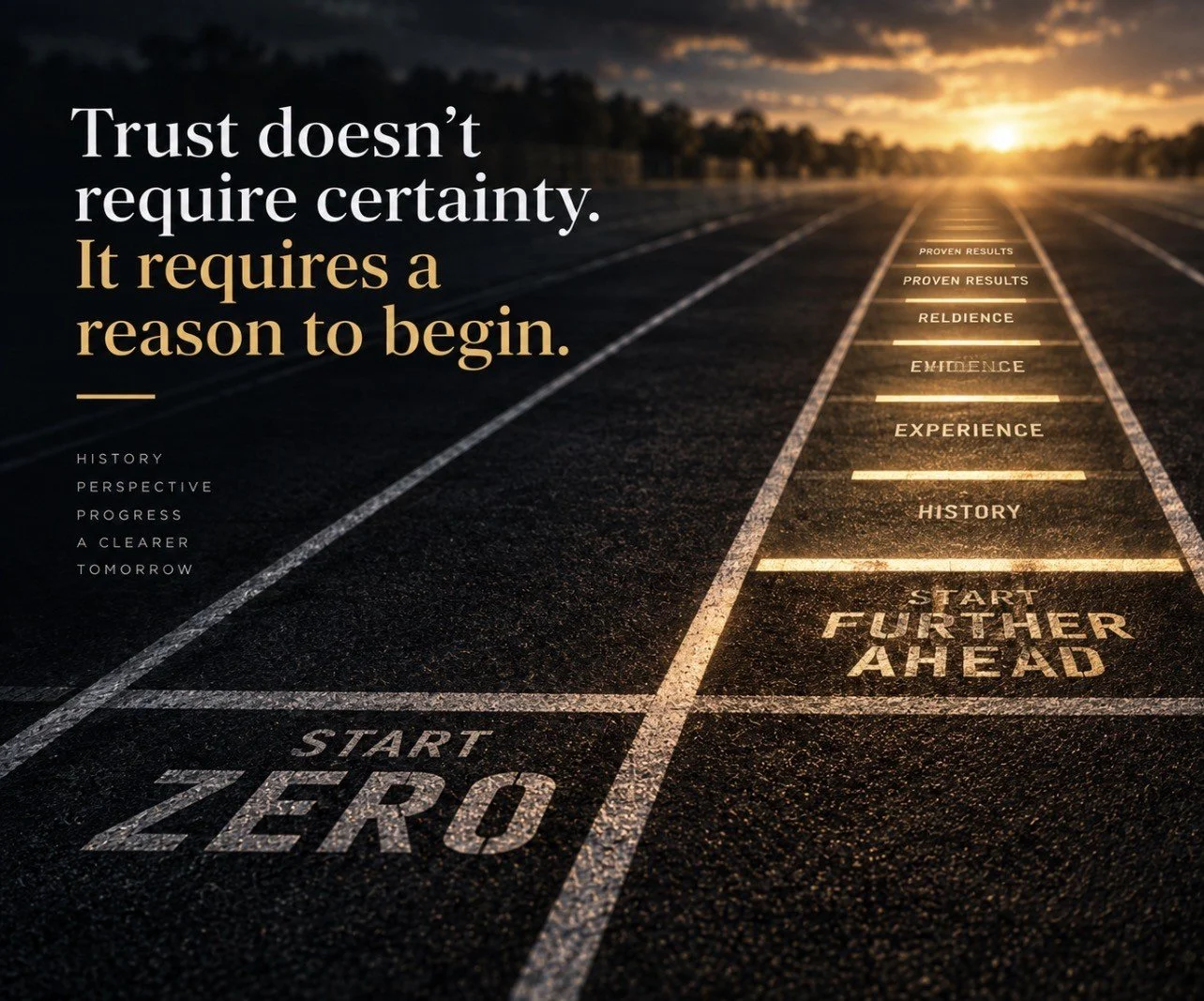
Trust Doesn't Require Certainty
We ask trust to do something it was never designed to do.
Remove uncertainty.
Before hiring someone, we want to know they'll perform.
Before working with a new carrier, we want to know they'll deliver.
Before giving someone responsibility, we want to know they'll handle it well.
Before beginning a relationship, we want some assurance about how it will end.
But we can't have that.
No résumé can provide it.
No reference can provide it.
No rating can provide it.
No amount of data can provide it.
Trust has never meant knowing what will happen next.
It means having enough reason to move forward anyway.
Every New Relationship Contains Risk
Think about the first time you worked with someone who eventually became one of your most trusted relationships.
At some point, they were unknown.
Someone had to make the first call.
Give them the first opportunity.
Assign the first load.
Make the first hire.
Extend the first bit of responsibility.
There was no certainty.
There was a decision made with whatever information was available at the time.
Then something happened.
They performed.
So the next decision became a little easier.
Then they performed again.
Eventually, the relationship felt different.
Not because risk disappeared.
Because history accumulated.
Trust Changes the Starting Point
That's one of the most useful things about trust.
It changes where the next decision begins.
Imagine you've worked with the same carrier successfully for five years.
A load becomes available tomorrow.
You don't approach that carrier as though you've never met.
You don't repeat every question you asked five years ago.
You don't reconstruct the entire relationship from scratch.
History has changed the starting point.
The same thing happens with people.
If someone has demonstrated good judgment repeatedly, we generally give their judgment more weight the next time.
If someone consistently follows through, we're more comfortable depending on them again.
Past performance doesn't guarantee the future.
But pretending the past tells us nothing would be equally irrational.
The Problem Is That Starting Points Reset
Inside established relationships, trust works remarkably well.
Outside them, much of its efficiency disappears.
Change employers.
Change customers.
Change platforms.
Change carriers.
Change brokers.
Change industries.
Suddenly, someone who may have spent years accumulating demonstrated history can find themselves remarkably close to zero again.
The new decision-maker doesn't necessarily distrust them.
They simply don't know what everyone else already learned.
That's an important distinction.
Unknown isn't the same as untrustworthy.
But operationally, we often treat them almost the same.
Uncertainty Has a Cost
When we don't know, we compensate.
We ask more questions.
Request more documentation.
Make more calls.
Seek more references.
Add more approvals.
Create more checkpoints.
Sometimes that's exactly what we should do.
Diligence matters.
But uncertainty also creates friction.
And some of that friction exists simply because useful history didn't arrive with the opportunity.
Imagine meeting someone new while already knowing:
They've done this before.
Other credible people have worked with them.
Their history can be examined.
The evidence has context.
Positive and negative events are both visible.
Patterns have developed over time.
You still make the decision.
You simply don't make it from zero.
That's Different From a Score
It's tempting to solve uncertainty by creating a number.
82%
4.8 stars.
Gold status.
Low risk.
Approved.
Numbers are efficient.
But efficiency can create false confidence.
Two people with the same score may have arrived there through completely different histories.
And two organizations looking at the same history may reasonably reach different conclusions.
A shipper may care deeply about one characteristic.
A carrier another.
A broker another.
An insurer another.
That's not a flaw.
Different decisions require different judgment.
The goal shouldn't necessarily be to create one answer everyone must accept.
The opportunity may be to give everyone a better starting point from which to make their own decision.
Trust Is Really a Reduction in Uncertainty
Not elimination.
Reduction.
That's why history matters.
That's why context matters.
That's why independent evidence matters.
Each gives us another reason to understand who—or what—we're dealing with.
Enough evidence doesn't make the future certain.
It makes the unknown less unknown.
And that can be enormously valuable.
Especially in industries where thousands of decisions are made every day between people and organizations that may never have worked together before.
Transportation is one of those industries.
The freight may need to move today.
The decision may need to happen in minutes.
There isn't always time to spend years developing a relationship first.
Maybe Trust Can Arrive Before the Relationship Does
Historically, trust was largely created inside relationships.
We worked together.
We learned about one another.
Trust developed.
Then we used that trust to make the next decision.
But what if some of the history created in previous relationships could responsibly inform the next one?
Not as a guarantee.
Not as an automatic approval.
Not as somebody else's judgment imposed on us.
As evidence.
A reason to begin somewhere other than zero.
That would change something important.
A new relationship could still be new.
Without everyone involved having to be unknown.
There will always be uncertainty in business.
There should be.
People change.
Companies change.
Circumstances change.
Good histories don't guarantee good outcomes.
And no system should pretend otherwise.
But there's a large distance between certainty and knowing nothing.
That's where trust has always lived.
Not in guarantees.
In evidence.
History.
Experience.
Patterns.
Reasons to proceed.
Perhaps the goal isn't to eliminate uncertainty.
It's to make fewer good decisions begin without the benefit of what has already been learned.
Because trust doesn't require certainty.
It requires a reason to begin.
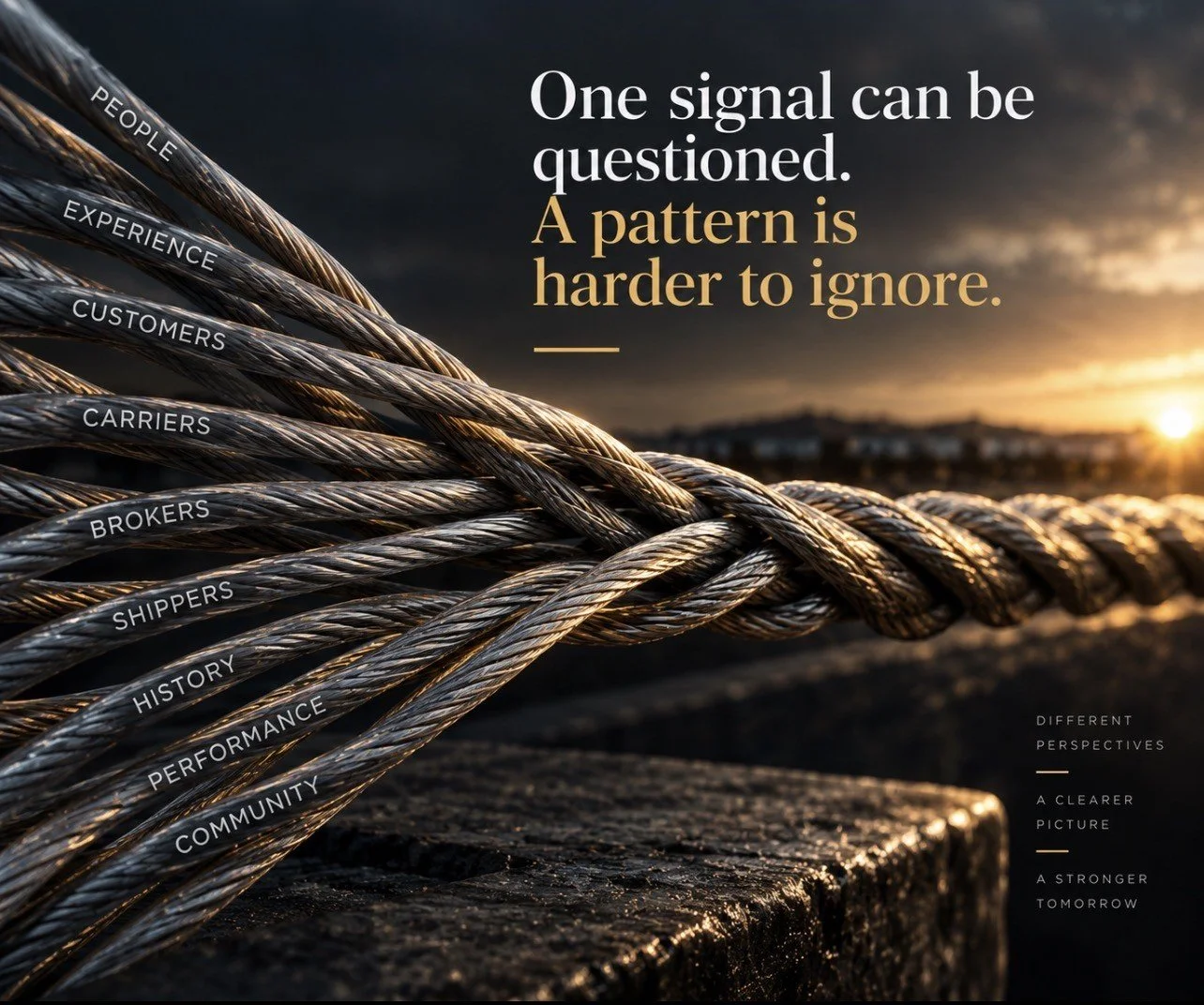
Trust Is Harder to Manufacture Than a Profile
Almost anyone can create a good profile.
Choose the right photo.
Write the right description.
List the right experience.
Highlight the right accomplishments.
Ask a few people for recommendations.
Given enough time, most of us can create a reasonably convincing version of ourselves.
That's not necessarily dishonest.
It's simply how profiles work.
We choose what other people get to see.
Reputation works differently.
A Profile Is Created. A Reputation Emerges.
There's an important distinction between the two.
A profile is largely something we construct.
A reputation is something other people gradually discover.
You don't become reliable because you write reliable in a bio.
People decide you're reliable after watching you follow through repeatedly.
You don't become professional because someone endorses you.
People begin describing you that way after experiencing how you operate.
And you don't become trusted because a system assigns you a badge.
Trust develops because enough experiences have given someone reason to believe what will happen next.
Profiles describe us.
Reputations are discovered through us.
One Person Can Be Persuaded
This is one reason references have always been useful—and imperfect.
A strong reference can tell us something meaningful.
But we also know how the process works.
People generally provide references from people they expect will speak positively about them.
Companies showcase their happiest customers.
Websites publish their strongest testimonials.
Candidates highlight their best accomplishments.
Again, none of that is inherently wrong.
But the information has been selected.
That's different from reputation developing across relationships someone didn't necessarily choose.
A dispatcher.
A customer.
A manager.
A mechanic.
A broker.
A shipper.
A carrier.
A driver.
Each experiences a different part of someone's professional behavior.
And something interesting happens when those independent experiences begin pointing toward the same conclusion.
The story becomes much harder to manufacture.
Reputation Gets Stronger When No One Person Controls It
Imagine two drivers.
The first tells you:
"I'm dependable, professional and take great care of my equipment."
Maybe that's true.
The second has years of history in which different people, organizations and events independently reveal those same characteristics.
No single person created the story.
No single company controls it.
No individual interaction proves it.
But the pattern is difficult to ignore.
That's fundamentally different from a rating.
The strength comes from independence.
The Same Is True for Companies
We already understand this intuitively.
Suppose a carrier tells a prospective shipper:
"We're one of the most reliable carriers in the market."
That's marketing.
Now imagine that shipper could see consistent evidence across years of relationships.
Different brokers.
Different customers.
Different facilities.
Different drivers.
Different circumstances.
And the same operational characteristics kept appearing.
Communication.
Follow-through.
Professionalism.
Problem solving.
Reliability.
Now the carrier isn't simply describing itself.
Its history is describing it.
That's much more interesting.
This Is Why Networks Matter
Networks are often discussed in terms of size.
How many users?
How many companies?
How many connections?
Those numbers matter.
But there may be another way to think about the value of a professional network.
Every legitimate relationship creates another opportunity for reality to reveal itself.
One interaction tells us very little.
Ten begin to tell us something.
Hundreds, across independent relationships and circumstances, can reveal patterns that no résumé, testimonial or self-authored profile could reproduce.
The network doesn't create the reputation.
The work does.
The network simply makes more of the evidence visible.
That Also Makes Trust More Difficult to Game
Any trust system eventually encounters the same problem:
What stops people from manipulating it?
If reputation depends primarily on what someone says about themselves, manipulation is easy.
If it depends on a handful of ratings, manipulation becomes harder—but still possible.
If it depends on demonstrated activity across independent relationships over time, something changes.
Manufacturing the appearance of trust begins requiring someone to manufacture reality itself.
They would have to repeatedly perform.
Across different relationships.
Across different circumstances.
Over time.
At some point, pretending to be trustworthy starts looking remarkably similar to actually behaving in a trustworthy way.
That's a useful property for any system built around reputation.
No Single Voice Should Define Someone
There's another side to this.
Distributed reputation doesn't only make positive claims harder to manufacture.
It can make negative judgments fairer too.
One person shouldn't necessarily be able to define another person's professional identity.
One disagreement.
One difficult customer.
One bad manager.
One failed load.
One mistake.
Those things may matter.
But when they're placed beside a much broader history, we can better understand what they represent.
A pattern?
Or an exception?
The same structure that makes reputation harder to inflate can also make it harder to unfairly destroy.
More independent evidence doesn't just strengthen trust.
It can strengthen fairness.
The Most Credible Story May Be the One Nobody Wrote
For years, we've built professional identity around profiles.
Résumés.
Applications.
References.
Ratings.
Testimonials.
They're useful.
They aren't going away.
But perhaps the next evolution of professional reputation looks less like a page someone creates and more like a history that gradually emerges.
Not one company deciding who you are.
Not one platform assigning your worth.
Not you telling everyone what they should believe.
Something more organic.
Thousands of legitimate interactions.
Different relationships.
Different circumstances.
Independent evidence accumulating over time.
Until eventually, the pattern becomes difficult to manufacture—and equally difficult to ignore.
Because the strongest reputation isn't the story someone tells about themselves.
It's the story their work keeps telling through everyone who encounters it.

Your Reputation Should Outlast Your Relationship
Most professional relationships eventually end.
People change jobs.
Customers change vendors.
Drivers change carriers.
Carriers change brokers.
Managers retire.
Companies merge.
Technology platforms come and go.
None of that is unusual.
But something strange often happens when the relationship ends.
Much of the reputation built inside it stays behind.
We Build Reputation Everywhere
Think about how professional reputation actually develops.
It isn't created by a résumé.
It's created through hundreds, sometimes thousands of interactions.
You show up.
You follow through.
You solve problems.
You communicate when something goes wrong.
You make good decisions when nobody is watching.
People learn what they can expect from you.
Eventually, trust develops.
But much of the evidence behind that trust becomes attached to the organization where the work happened.
The customer history belongs to the CRM.
The performance records belong to the employer.
The reviews belong to the platform.
The operational history lives inside company systems.
The relationships live inside people's heads.
Then someone leaves.
And an enormous amount of accumulated professional context becomes difficult to carry forward.
The relationship ended.
The reputation shouldn't have to.
We Already Understand This in Other Parts of Life
Imagine if your financial history disappeared every time you changed banks.
Or your education disappeared when you moved to another state.
Or your professional license had to be re-earned every time you changed employers.
That would make little sense.
Those things describe something about you, even though other institutions helped verify them.
Professional reputation is different.
Much of it remains trapped inside the relationships and systems where it was created.
A driver can spend ten years building an exceptional reputation with a carrier and still walk into the next opportunity largely carrying a résumé and a handful of references.
A carrier can perform exceptionally for one shipper while the next shipper knows almost nothing about that history.
A broker can build years of trusted relationships, move companies, and suddenly find much of that credibility difficult to demonstrate.
The value existed.
The problem is that it didn't travel very well.
There Is a Difference Between Owning a Claim and Carrying Evidence
This doesn't mean people should be able to write their own professional histories.
That's not reputation.
That's marketing.
"I'm reliable."
"I'm safe."
"I'm great to work with."
"Customers love me."
Those are claims.
Useful professional history requires something stronger.
Evidence created by other people.
Evidence created through actual work.
Evidence that has provenance.
Evidence that can be corroborated.
Evidence that someone can't simply manufacture because they want the story to look better.
That creates an interesting distinction:
The individual shouldn't control the truth.
But they should be able to benefit from the truth they've earned.
Reputation Has Historically Been Borrowed From Relationships
For most of human history, this problem was solved socially.
Someone called someone.
"Do you know Mitch?"
"Yes. I've worked with him for years."
"Would you hire him?"
"Absolutely."
Trust traveled through the person willing to vouch for you.
That system still works remarkably well.
But it has limitations.
It depends on who you know.
Who answers the phone.
Who remembers.
Who is still at the company.
And whether the person making the next decision happens to reach the right person.
The reputation may exist.
Access to it is inconsistent.
That's Especially Important in a Mobile Workforce
Transportation makes this problem easy to see.
People and companies constantly move between relationships.
A driver changes carriers.
A dispatcher changes employers.
A salesperson moves to another brokerage.
A carrier begins working with a new shipper.
A fleet hires someone new.
A customer changes providers.
Every transition creates another moment where trust has to be rebuilt.
Some rebuilding is healthy.
Past performance should never guarantee future opportunity.
But starting completely over doesn't make much sense either.
A new relationship doesn't erase an old history.
Portable Doesn't Mean Permanent
There's an important guardrail here.
A portable reputation shouldn't become a permanent label.
People improve.
Circumstances change.
Companies change.
Someone who struggled five years ago may be exceptional today.
Someone with an excellent history can still make a bad decision tomorrow.
That's another reason a single score is such an inadequate way to represent reputation.
History should provide context.
Not a verdict.
The purpose isn't to freeze someone in time.
It's to allow the next decision to begin with more knowledge than the last one ended with.
The Person Changes Jobs. The Evidence Doesn't Have To.
There may eventually be a different way to think about professional identity.
Not as a profile someone fills out.
Not as a rating somebody owns.
Not as information trapped inside one company's database.
But as a continuously developing history supported by the organizations and people encountered along the way.
Every relationship could contribute something.
Every meaningful interaction could strengthen - or challenge - the existing picture.
And over time, professional reputation could become something much closer to what it has always claimed to be:
a reflection of demonstrated history.
The employer would still own its records.
The customer would still own its experience.
The platform would still own its system.
But the person whose actions created that history wouldn't necessarily have to leave all of its value behind.
We spend years building professional reputations.
Sometimes decades.
They influence who trusts us, who hires us, who works with us, and which opportunities become available to us.
That makes reputation an unusual kind of asset.
Other people help create it.
Other people help verify it.
No one should be able to manufacture it.
But the person who earned it should be able to benefit from it.
Even when a relationship ends.
Even when an employer changes.
Even when the next opportunity exists somewhere else.
Your reputation shouldn't belong to the place you worked.
It should follow the work you've done.
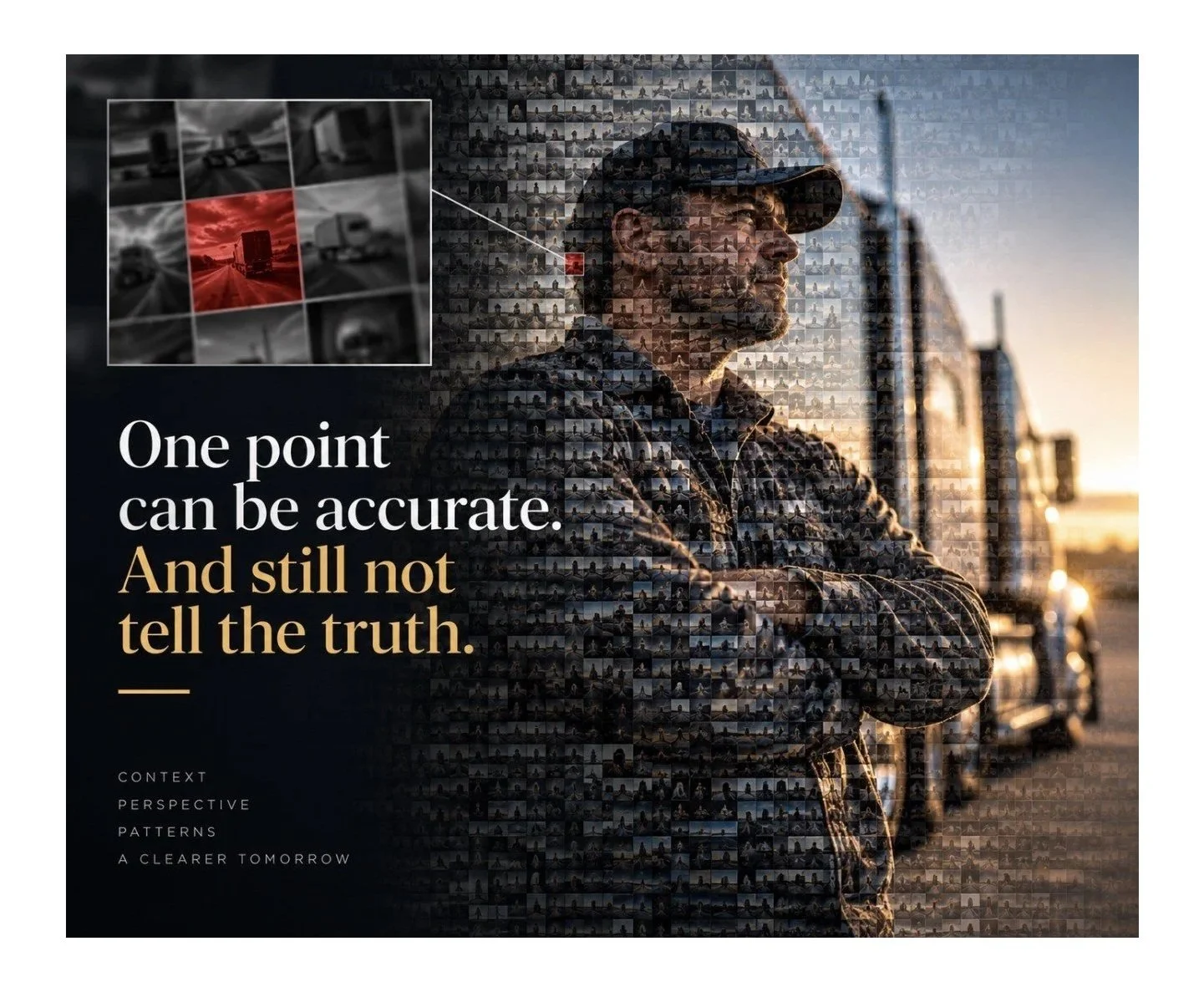
The Difference Between Data and Evidence
We have more data than we’ve ever had.
Especially in transportation.
Arrival times.
Departure times.
Inspection records.
Safety events.
Maintenance records.
Miles driven.
Loads completed.
Service failures.
Customer complaints.
Driver turnover.
Nearly everything creates a data point.
And yet, somehow, we still struggle to answer a much simpler question:
Who should I trust?
I think part of the problem is that we’ve started treating data and evidence as though they’re the same thing.
They’re not.
A data point tells you something happened.
Evidence helps you understand what that something means.
Imagine a driver arrives two hours late to a delivery.
The data says:
Late.
That may be completely accurate.
But what if the driver spent four hours waiting at the previous receiver?
What if an interstate was closed because of an accident?
What if weather forced traffic to stop?
What if the appointment time was changed after the driver was already dispatched?
None of those things make the original data point false.
They make it incomplete.
And incomplete information can become misleading remarkably quickly when we turn it into a judgment about someone.
Context Changes the Signal
Transportation is filled with situations like this.
A broker sees a late delivery.
A carrier sees a service failure.
A shipper sees detention.
A driver sees an equipment problem.
Each party may possess an accurate piece of information.
But no single piece necessarily tells the whole story.
That's why I've become increasingly interested in the distinction between recording events and building evidence.
Evidence requires more than accumulation.
It requires context.
It requires provenance—where did the information come from?
It requires repetition—is this an isolated event or part of a pattern?
And, when possible, it requires corroboration—does other information support the same conclusion?
Those things transform isolated data points into something much more useful:
a signal.
Patterns Matter More Than Moments
Suppose that same driver has completed 1,200 loads.
The record shows consistent communication.
Regular equipment inspections.
Strong safety performance.
Very few service failures.
And hundreds of examples of doing exactly what was expected.
Then comes one late delivery.
Which tells us more about that driver?
The one failure?
Or the 1,199 other pieces of evidence?
Obviously, the failure still matters.
But now we know how much weight to give it.
That's what history does.
History gives individual events proportion.
Without history, every new event can become disproportionately important.
With history, we can begin distinguishing an exception from a pattern.
And that distinction matters enormously when people's livelihoods, businesses, and reputations are affected by the conclusions we draw.
More Data Isn't Necessarily More Truth
This is where I think something interesting is happening across transportation.
We're getting extraordinarily good at collecting information.
But collecting more information doesn't automatically create better decisions.
In some cases, it may actually create more opportunities to misunderstand people.
A thousand disconnected data points are still disconnected data points.
What matters is whether we can determine:
Who created the information?
When did it happen?
What was happening around it?
Can it be independently supported?
Has this happened repeatedly?
How does it compare with the person's broader history?
Those questions move us from data collection toward evidence.
And evidence moves us closer to trust.
Reputation Should Be Built Like a Case
Think about how we make important judgments in almost every other part of life.
We rarely trust one observation.
We look for patterns.
Consistency.
Independent confirmation.
History.
Context.
The stronger the decision, the stronger we generally expect the evidence behind it to be.
Yet professional reputation is still surprisingly vulnerable to isolated moments.
One bad load.
One complaint.
One disagreement.
One rating.
One checkbox in somebody else's system.
Sometimes those events reveal something important.
Sometimes they don't.
The problem isn't that negative information exists.
The problem is when we don't have enough surrounding evidence to know what it means.
What If Work Created Its Own Evidence?
This is the idea I keep coming back to.
What if the everyday work people already perform gradually created a verifiable history?
Not another résumé.
Not another star rating.
Not another place where people simply tell us they're trustworthy.
Actual evidence created through work.
Inspections completed.
Commitments kept.
Problems communicated.
Maintenance documented.
Loads delivered.
Issues resolved.
Professional behavior repeated over time.
No individual event would need to define someone.
Instead, thousands of small actions could slowly reveal something much harder to manufacture:
a pattern.
And patterns are where trust begins.
Transportation doesn't have a shortage of data.
It may have the opposite problem.
What we need is a better way to determine which information deserves weight, how much weight it deserves, and what the broader history tells us.
Because ultimately:
A data point tells us what happened.
Context tells us why.
Patterns tell us what to believe.
And evidence gives us a reason to trust.
That's a distinction worth building around.
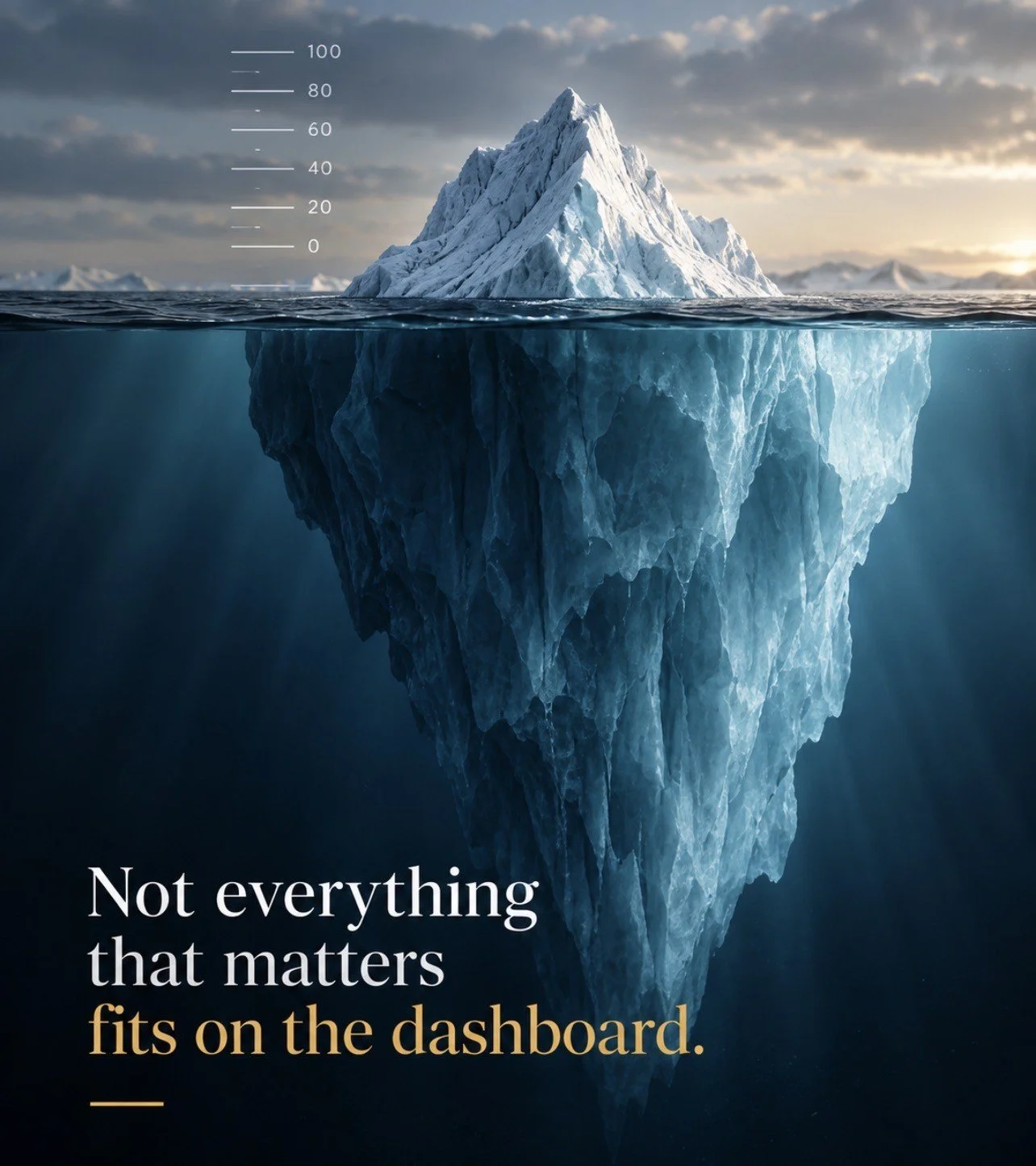
What We Measure Becomes What We See
There's an old tendency in business.
If something matters, measure it.
Usually, that's good advice.
Measurement creates accountability.
It helps us identify problems.
It allows us to compare performance.
It gives organizations something more reliable than intuition alone.
But measurement creates another effect that's easier to miss.
What we measure becomes easier to see.
And eventually, what we can see begins influencing what we believe matters.
Visibility Has Consequences
Consider two things happening inside an organization.
One appears on a dashboard every morning.
The other is experienced repeatedly by customers, coworkers or partners but isn't formally captured anywhere.
Which one gets discussed in the meeting?
Usually the first.
Which one gets analyzed?
The first.
Which one influences decisions?
Again, probably the first.
Not necessarily because it's more important.
Because it's visible.
Over time, that creates a subtle distortion.
We can begin mistaking what is measurable for what is meaningful.
Some of the Most Valuable Things Are Difficult to Count
Reliability is a good example.
So is judgment.
Professionalism.
Preparation.
Follow-through.
Communication.
The ability to recognize a problem before it becomes one.
Ask an experienced manager who their best people are, and they'll usually have an answer.
Then ask why.
The explanation rarely fits neatly into one metric.
"She just handles things."
"Customers trust him."
"When something goes sideways, that's who I want involved."
"If he says it's taken care of, I don't worry about it."
Those statements aren't particularly sophisticated.
But they're describing something enormously valuable.
Accumulated confidence.
The organization knows something.
It just may not have a field for it.
Transportation Is Full of Invisible Performance
A professional driver makes hundreds of decisions that never appear on a scorecard.
How carefully was the equipment inspected?
Was something unusual noticed?
Was a developing problem communicated?
Was the customer treated professionally?
Was the equipment cared for?
Was a difficult situation handled well?
Did someone take responsibility when taking the easier route was possible?
Some of those behaviors eventually produce measurable outcomes.
Many don't.
Especially when they're done well.
A good decision may prevent the event that would have created the data.
That's an interesting paradox.
Sometimes excellent performance produces less evidence precisely because it prevented something from happening.
That Doesn't Mean We Should Measure Everything
This is where I think the conversation can go wrong.
If valuable behavior isn't visible, the instinct can be:
Measure more.
Score more.
Track more.
Rate more.
Turn every interaction into another data point.
I'm not convinced that's the answer.
People aren't spreadsheets.
And reputation isn't an equation.
Trying to quantify every dimension of human performance can create false precision while losing the context that made the information valuable in the first place.
The better question may be different:
What evidence is worth preserving?
Not everything.
The meaningful things.
The things that help establish patterns.
The things that tell us something about how someone actually operates.
The things another decision-maker would reasonably want to know.
Evidence and Measurement Aren't the Same Thing
That's a distinction worth making.
Measurement asks:
How much?
How often?
How fast?
What score?
Evidence can answer different questions.
What happened?
Who observed it?
What was the context?
Has something similar happened before?
What does the pattern suggest?
Sometimes measurement is the evidence.
Sometimes it isn't.
Both can matter.
But confusing the two can cause organizations to overlook enormous amounts of useful information simply because it doesn't fit comfortably into a column.
Experienced People Have Always Known This
One reason institutional knowledge is so valuable is that experienced people accumulate context systems don't.
They remember the customer who is difficult but fair.
The employee whose numbers don't fully explain their value.
The vendor who becomes exceptional when things go wrong.
The driver who everyone wants on the difficult account.
The carrier that communicates before anyone has to ask.
Those judgments aren't necessarily arbitrary.
Often, they're based on hundreds of observations accumulated over years.
The problem is that when the person carrying that understanding leaves, much of the understanding leaves too.
The spreadsheet remains.
The context doesn't.
Maybe the Opportunity Is Better Memory
Organizations don't necessarily need to measure everything that matters.
Maybe they need to become better at remembering it.
Preserving meaningful evidence.
Connecting observations.
Recognizing patterns.
Allowing demonstrated history to accumulate.
Not so a system can decide what someone is worth.
But so the next person making a decision doesn't have to rely only on whatever happens to fit inside the existing fields.
Because the goal isn't perfect measurement.
It isn't perfect knowledge either.
It's better visibility.
Enough visibility to understand more of what's actually happening.
Enough context to recognize patterns that would otherwise disappear.
Enough history to make better-informed decisions.
Numbers matter.
Metrics matter.
Records matter.
They always will.
But the most valuable organizations I've encountered also know things that can't be found on the dashboard.
They know who performs.
Who follows through.
Who others trust.
Who makes good decisions.
Who they'd choose again.
That knowledge already exists.
The opportunity isn't to turn all of it into a score.
It's to stop letting so much of it disappear.
The Problem With Work That Goes Right
Something interesting happens when work goes wrong.
We document it.
An accident creates a record.
A service failure creates a record.
A complaint creates a record.
A missed appointment creates a record.
A violation creates a record.
A claim creates a record.
Organizations have become remarkably good at remembering exceptions.
And for good reason.
Problems matter.
Risk matters.
Accountability matters.
But there's another side of the ledger that receives considerably less attention.
What happens when the work simply goes right?
Success Is Often Quiet
Someone shows up when they're supposed to.
They do the work well.
They communicate.
They notice a problem before it becomes a larger one.
They take care of the equipment.
They make a good decision when nobody is watching.
They deliver.
Then they do it again tomorrow.
Nothing extraordinary happens.
Which is precisely the point.
Reliability often looks remarkably uneventful from the outside.
There is no incident report.
No escalation.
No investigation.
No corrective action.
Sometimes there isn't even a record that anything particularly valuable happened.
Good work frequently disappears because nothing went wrong.
Our Systems Have a Natural Bias
Most operational systems weren't designed to build reputations.
They were designed to manage operations.
So they capture the things necessary to do that.
Transactions.
Exceptions.
Compliance.
Failures.
Costs.
Outcomes.
The result can create a strange imbalance.
One negative event may become highly visible because the system was specifically designed to record it.
Meanwhile, hundreds of positive behaviors remain largely invisible because there was never a reason to create a record.
Think about what that does over time.
The exceptional failure persists.
The ordinary excellence fades.
Not because one matters more than the other.
Because one was easier to see.
Transportation Makes This Especially Visible
Consider a professional driver.
Thousands of miles.
Hundreds of inspections.
Pre-trips completed.
Equipment cared for.
Appointments met.
Problems identified.
Customers treated professionally.
Difficult conditions navigated safely.
Day after day of decisions that help freight arrive where it belongs.
Much of the value lies precisely in the absence of an event.
Nothing happened.
The tire issue was noticed before the failure.
The equipment problem was addressed before the roadside breakdown.
The difficult situation never became an incident.
The customer never had to call.
The load arrived.
Everyone moved on.
That's good operations.
But it's surprisingly difficult to build a durable professional history from things that didn't go wrong.
Absence of Failure Isn't the Same as Evidence of Excellence
That's an important distinction.
A clean record can tell us something.
But it doesn't necessarily tell us everything we'd like to know.
There is a difference between:
"We don't have evidence that this person performed poorly."
and:
"We have evidence that this person consistently performed well."
Those statements sound similar.
They're not.
One is the absence of a negative signal.
The other is the presence of positive evidence.
And when we're making decisions about people, partners or risk, that difference can matter enormously.
We Tend to Notice This Only When Someone Leaves
I've seen versions of this throughout my career.
Someone spends years becoming extremely valuable inside an organization.
Everyone who works with them knows it.
Customers know it.
Coworkers know it.
Managers know it.
Then something changes.
They leave.
The relationships scatter.
The institutional memory begins fading.
And the next organization evaluating that person receives a résumé.
Maybe some references.
Maybe a few records.
Perhaps some performance data.
But much of what made that person valuable was never really captured.
It was experienced.
That's an enormous difference.
A reputation can be real without being portable.
And good work can be valuable without becoming durable.
What If Ordinary Excellence Left Evidence?
Not applause.
Not participation trophies.
Not another five-star rating system.
Evidence.
A history that gradually becomes more useful because it reflects what actually happened.
Work completed.
Commitments kept.
Problems identified.
Responsibility demonstrated.
Patterns repeated.
Context accumulated.
No single moment would need to prove very much.
That's not how reputation works anyway.
But over time, something meaningful could emerge.
A record not merely of the problems someone avoided—
but of the value they consistently created.
That Could Change the Starting Point
Imagine two people being evaluated for the same opportunity.
Today, much of the decision may begin with credentials, requirements and whatever history happens to be accessible.
That's reasonable.
But imagine one of those people could also bring years of demonstrated professional behavior with them.
Not claims about who they are.
Evidence of how they've operated.
The conversation changes.
Not because the evidence guarantees what they'll do next.
Nothing can.
But the decision no longer begins with quite as much uncertainty.
Their previous work has earned them something.
A better starting point.
We spend enormous energy designing systems that remember when something goes wrong.
We should.
Failures teach us things.
Risk needs to be understood.
Accountability matters.
But perhaps we've underinvested in the other half of the equation.
The millions of ordinary actions that make organizations function precisely because they don't become problems.
Those actions matter too.
And over a career, they can tell an extraordinarily important story.
The question is whether anyone gets to see it.
Because the absence of failure shouldn't be the highest form of professional recognition available to someone who has spent years doing things right.
Good work shouldn't disappear simply because nothing went wrong.
The Best Infrastructure Removes Questions
We tend to notice infrastructure when it fails.
The power goes out.
The internet stops working.
A payment doesn't process.
A road closes.
Suddenly, something we barely thought about becomes impossible to ignore.
But when infrastructure works well, the opposite happens.
We almost forget it's there.
It quietly removes obstacles between where we are and where we're trying to go.
Good infrastructure doesn't demand attention.
It makes progress easier.
Think about how many things happen today because someone else already solved the underlying problem.
We don't negotiate with every bank involved when we use a credit card.
We don't establish a relationship with every network our phone call crosses.
We don't need to understand every server involved before sending an email.
We act.
The infrastructure handles much of what would otherwise stand between intention and outcome.
And that creates something extraordinarily valuable.
Not just convenience.
Confidence to proceed.
Business Has Its Own Version of Friction
Anyone who has spent enough time operating a business recognizes it.
Before something can happen, someone needs to know:
Who are these people?
Have we worked with them before?
Can they do what they say they can do?
Has anyone verified this?
What happened the last time?
Who knows them?
Who can vouch for them?
Where is the documentation?
Sometimes those are exactly the questions we should be asking.
But what's interesting is how often organizations have already encountered the information needed to answer them.
The problem is finding it.
Or verifying it.
Or connecting it.
Or discovering that someone who knew the answer left the company two years ago.
So the question gets asked again.
And the work begins again.
Friction Often Looks Like Caution
That's an important distinction.
Organizations are sometimes criticized for moving slowly.
Too many approvals.
Too many checks.
Too much diligence.
Too much bureaucracy.
And sometimes that's fair.
What looks like bureaucracy from the outside can simply be an organization compensating for uncertainty.
When information is incomplete, people verify.
When history is inaccessible, people investigate.
When trust hasn't traveled, people rebuild it.
Uncertainty creates work.
And much of that work is entirely rational.
If the consequences of making a bad decision are meaningful, asking another question makes sense.
So does another phone call.
Another database search.
Another approval.
Another layer of verification.
The interesting question isn't:
How do we convince organizations to ask fewer questions?
It's:
What would have to become visible so some of those questions no longer needed to be asked?
That's What Infrastructure Can Change
The best infrastructure doesn't eliminate diligence.
It makes diligence more efficient.
It doesn't tell someone:
"Trust this person."
It makes relevant history easier to see.
It doesn't say:
"Approve this company."
It provides better context for the decision.
It doesn't eliminate judgment.
It allows judgment to begin from somewhere better than zero.
That's a fundamentally different proposition.
Because the goal shouldn't be removing humans from important decisions.
The goal should be removing unnecessary friction from the decisions humans still need to make.
Transportation Is Full of These Moments
A carrier needs to evaluate a driver.
A broker needs to evaluate a carrier.
A shipper needs confidence in the people and companies handling its freight.
An insurer needs to understand risk.
A driver needs an opportunity.
A recruiter needs to know whether someone deserves one.
Every participant is trying to answer a slightly different question.
But beneath many of them sits the same underlying problem:
What do we actually know?
Today, answering that question can require moving between systems, records, relationships and memories.
And even after all of that, useful history can remain invisible.
That's not because the industry lacks information.
It has enormous amounts of it.
The friction exists because information and trust don't always move as easily as the work itself does.
The Most Valuable Systems Eventually Become Invisible
There's a paradox in great infrastructure.
The more useful it becomes, the less people think about it.
Nobody celebrates the payment network every time a credit card works.
Nobody marvels at telecommunications infrastructure every time a call connects.
We simply expect it.
That's what happens when something moves from being a tool to becoming part of how the world operates.
It stops being another destination.
It becomes an enabling layer beneath the destinations people already use.
That distinction matters.
Because perhaps the future of professional trust isn't another place everyone has to visit.
Maybe it's something that helps the places they already visit work better.
A layer that allows demonstrated history to remain useful.
A layer that helps context survive organizational boundaries.
A layer that makes credible signals easier to find when a decision needs to be made.
Not to make the decision.
To make the decision better informed.
Trust Should Reduce Friction
Trust has always done this.
When we know someone, things move faster.
When we've worked together before, fewer questions need answering.
When someone has demonstrated reliability repeatedly, we don't approach every interaction as though it's the first.
History creates efficiency.
That's one of trust's least appreciated economic properties.
Trust doesn't just make relationships stronger.
It makes transactions easier.
And when that principle can extend beyond the boundaries of a single relationship, company or platform, the implications become much larger.
Because now we're no longer just preserving reputation.
We're reducing the cost of uncertainty.
There will always be questions worth asking.
There should be.
Good judgment requires them.
But perhaps progress isn't about eliminating questions.
It's about ensuring we don't keep asking questions that credible history has already answered.
Because every organization has limited time.
Limited attention.
Limited resources.
The more energy spent rediscovering what was already known, the less remains for everything else.
The best infrastructure doesn't make decisions for us.

Trust Becomes More Valuable When It Can Travel
Trust travels through people.
A phone call.
A reference.
An introduction.
Someone saying:
“I've worked with her before.”
“I know that company.”
“I'd trust him with it.”
For a long time, that was one of the most effective systems we had.
And in many ways, it still is.
But there's an interesting limitation built into that model.
Trust can only travel as far as the relationship carrying it.
I've thought about that a lot.
Because most of the trust created in business isn't created by systems.
It's created by people.
A driver consistently does good work.
A carrier repeatedly follows through.
A salesperson earns the confidence of a customer.
An operations leader handles difficult situations well.
A professional spends years becoming someone other people know they can count on.
The trust is real.
The problem is its reach.
Someone else has to know about it.
Or know someone who does.
Otherwise, much of that history becomes invisible again.
For most of human history, that limitation wasn't particularly unusual.
Trust was local.
Commerce was local.
Professional networks were smaller.
People worked within communities where reputation could travel reasonably well through relationships.
You knew someone.
Or you knew someone who knew someone.
That was the network.
But modern commerce doesn't operate that way anymore.
A driver in Minnesota can haul freight for a broker in Georgia on behalf of a shipper in California.
None of them may have met before.
A recruiter can evaluate someone hundreds of miles away.
A company can enter a relationship with another company it discovered yesterday.
Opportunity now travels almost instantly.
Trust doesn't.
That's an increasingly important mismatch.
We've solved versions of this problem before.
Think about the telephone.
The remarkable thing about a telephone isn't simply that it allows two people to talk.
It's that virtually any phone can reach virtually any other phone.
Different carriers.
Different devices.
Different locations.
The network works because the connection isn't confined to one company's private universe.
Email works much the same way.
You don't need the same email provider as the person you're contacting.
I can send an email from one service to someone using another because the underlying system allows information to move between them.
The value isn't simply in the individual application.
The value is in interoperability.
The network becomes more useful because participation doesn't require everyone to belong to the same closed system.
That principle has created some of the most important infrastructure in modern life.
And I've started wondering whether professional trust eventually needs something similar.
Today, reputation still tends to live inside containers.
An employer has one piece.
A customer has another.
A platform has another.
A safety department has another.
A recruiter remembers something else.
A colleague knows something none of those systems captured.
The pieces exist.
But they rarely operate as a connected whole.
Worse, many systems treat the information they collect as though the value belongs primarily to the system that collected it.
That makes sense from the perspective of the system.
I'm not sure it makes sense from the perspective of trust.
Because if a person earned the reputation, why should recognizing that reputation depend entirely on remaining inside the place where it was recorded?
That's a very different question.
And I think it points toward something larger.
Trust becomes more useful when it can cross boundaries.
Between employers.
Between platforms.
Between relationships.
Between different moments in a career.
Not automatically.
Not without verification.
And certainly not without context.
Portability shouldn't mean that every claim follows someone forever.
It should mean that demonstrated history doesn't unnecessarily disappear simply because the environment changes.
That's what makes open systems so powerful.
They allow value created in one place to remain useful somewhere else.
Transportation may be particularly well suited for this idea.
The industry is already a network.
Drivers move between carriers.
Carriers work with many brokers.
Brokers work with many shippers.
Shippers rely on enormous networks of people and companies they may never directly know.
Freight constantly crosses organizational boundaries.
But much of the trust surrounding the people moving it does not.
The freight travels better than the reputation does.
That's strange when you think about it.
We have built extraordinary infrastructure for moving the physical asset.
Roads.
Warehouses.
Distribution centers.
Tracking systems.
Payment networks.
Communication platforms.
Yet much of the context surrounding the people doing the work still moves through phone calls, references, isolated databases, and individual memory.
Those things remain valuable.
But they don't scale particularly well.
And they certainly don't create continuity.
I don't think the answer is one enormous database that decides who should be trusted.
That may actually recreate the problem in another form.
Trust is too contextual for that.
A great system shouldn't tell everyone what to think.
It should help them see what has been demonstrated.
Where the signal came from.
How it was established.
How consistently it has appeared.
And then allow the decision-maker to decide what it means.
That's an important distinction.
Shared infrastructure doesn't require shared judgment.
We can see the same information and reach different conclusions.
That's not a weakness.
That's how judgment works.
The infrastructure simply makes better context available before the judgment is made.
The more I've thought about this, the more convinced I've become that portability may only be the first step.
Because making reputation portable helps the individual.
Making trusted signals interoperable helps the network.
And those are different levels of value.
One allows what you've earned to travel with you.
The other allows the entire system to understand more than any individual participant could understand alone.
That's when something begins behaving less like an application.
And more like infrastructure.
Every great network eventually becomes more valuable because things can move across it.
Communication.
Money.
Information.
Goods.
Ideas.
Opportunity.
Perhaps trust belongs on that list.
Not trust as a universal score.
Not trust as something a company owns.
Not trust as something technology declares.
Trust as demonstrated history that can move.
Across relationships.
Across organizations.
Across careers.
Across an industry.
Because the value of trust shouldn't end at the boundary of the system where it was earned.
If trust is going to become infrastructure, it eventually has to do what all useful infrastructure does.
It has to connect.

When Independent Signals Point in the Same Direction
Most important decisions aren't made because of one piece of evidence.
We may begin there.
A résumé.
A credential.
A reference.
A performance record.
A recommendation.
A previous experience.
Each can tell us something.
But rarely does one tell us enough.
What creates confidence is often something more subtle.
Different pieces of evidence begin pointing in the same direction.
Trust Rarely Comes From One Source
Think about how we make an important hiring decision.
A candidate's experience looks right.
That's one signal.
Someone we trust recommends them.
Another.
Their previous performance supports what we've heard.
Another.
The interview reinforces the pattern.
Another.
At some point, something changes.
We aren't simply accumulating more information.
We're becoming more confident.
Not because any single piece of evidence proved the decision was right.
Because independent signals began reinforcing one another.
That's how confidence is often built in the real world.
Agreement Matters
Imagine hearing something positive about a company from one customer.
Useful.
Then another customer describes a similar experience.
More interesting.
Then someone inside your organization realizes they've worked with that company before and says essentially the same thing.
Now you begin paying attention.
The individual observations haven't necessarily become stronger.
What's changed is their relationship to one another.
They agree.
And agreement among independent experiences can be extraordinarily informative.
One signal creates an impression.
Converging signals create confidence.
Patterns Become Stronger When They Cross Boundaries
This is where reputation becomes particularly interesting.
A pattern observed inside one relationship may tell us something.
The same pattern appearing across different relationships tells us more.
Different customers.
Different organizations.
Different circumstances.
Different points in time.
Yet the same underlying behavior continues appearing.
Reliability.
Professionalism.
Follow-through.
Consistency.
Now we're no longer looking at a single person's opinion.
We're beginning to see something that may actually belong to the person or organization being observed.
That's an important distinction.
Because the strongest reputations aren't created when everyone repeats the same claim.
They're created when independent experiences repeatedly arrive at similar conclusions.
This Is How Experienced Operators Think
The best operators I've worked with rarely rely on one source.
They triangulate.
They ask around.
They compare what they're hearing with what they've experienced.
They look for inconsistencies.
They notice when different people who have no reason to coordinate are telling essentially the same story.
They're not necessarily doing this formally.
It's judgment developed through experience.
But underneath that judgment is a powerful principle:
Confidence increases when independent evidence converges.
We've relied on that principle for generations.
Mostly through relationships.
Phone calls.
References.
Reputation.
Institutional knowledge.
Someone knowing someone who knows someone.
It works remarkably well.
Until scale begins making those relationships harder to access.
The Opportunity Isn't to Replace Judgment
I think that's an important point.
Technology has a tendency to take something nuanced and attempt to reduce it to a number.
A score.
A rating.
A rank.
Those things can be useful.
But they can also create the illusion of certainty.
Real trust is rarely that simple.
Perhaps the more interesting opportunity is not telling people what to think.
It's helping them see more of the evidence they would have wanted before deciding for themselves.
Where did the signal originate?
What happened?
How often has the pattern appeared?
Across how many independent relationships?
Over what period of time?
Does other evidence reinforce it?
Now technology isn't replacing judgment.
It's strengthening the context surrounding it.
And that's a very different role.
Confidence Is Built Through Convergence
We will never eliminate uncertainty from important decisions.
Nor should we expect to.
People change.
Companies change.
Circumstances change.
The past never guarantees the future.
But we can become better at understanding what the past has demonstrated.
And when credible, independent experiences repeatedly point toward the same conclusion, something valuable begins to emerge.
Not certainty.
Confidence.
That's ultimately what decision-makers have always been searching for.
Not another data point.
Not another opinion.
Not another score.
Enough credible evidence, viewed together, to make a better-informed decision.
Because trust doesn't become stronger simply because we collect more signals.
It becomes stronger when the right signals begin telling the same story.

Not All Signals Are Equal
We make decisions from signals every day.
Some are obvious.
A credential.
A reference.
A recommendation.
A performance record.
A previous relationship.
Others are less formal.
Someone we've worked with before.
A pattern we've noticed over time.
A person whose judgment we've learned to trust.
Individually, each tells us something.
But they don't necessarily tell us the same thing.
And they shouldn't carry the same weight.
That's where things become interesting.
A Signal Is Only as Valuable as What Sits Behind It
Consider a recommendation.
Someone tells you:
"I've worked with her. She's excellent."
That's useful.
But immediately, we begin adding context.
Who made the recommendation?
How well do they know her?
Did they work together once or for ten years?
What kind of work did they do?
Was the person recommending her actually in a position to observe what they're describing?
We do this instinctively.
We're not simply evaluating the information.
We're evaluating the credibility behind it.
The same thing happens with almost every signal we use to establish trust.
The existence of a signal matters.
Its provenance matters more.
Frequency Matters Too
One positive experience tells us something.
Ten similar experiences tell us something different.
A single observation may be meaningful.
A repeated pattern is usually more meaningful.
That's how reputation develops in the real world.
Not through one moment.
Through consistency.
The same behavior.
Observed across time.
Across circumstances.
Perhaps even across different relationships.
Eventually, what initially looked like an isolated event begins to look like something else.
A pattern.
And patterns can be much more useful than snapshots.
Context Changes Meaning
Even seemingly objective information can mean different things depending on the circumstances surrounding it.
A delayed shipment tells us something.
But what caused the delay?
Weather?
Mechanical failure?
Poor planning?
A customer issue?
And perhaps more importantly:
What happened next?
Was communication proactive?
Was the problem handled professionally?
Was the customer taken care of?
The event itself is information.
The circumstances around it create understanding.
Without that context, we risk confusing what happened with what it means.
That's an important distinction whenever information begins influencing decisions about people or organizations.
More Signals Don't Automatically Create More Trust
We're entering an era where collecting information is becoming remarkably easy.
The temptation will be to assume that more information produces better understanding.
More ratings.
More reviews.
More metrics.
More observations.
More data.
But volume alone doesn't create credibility.
In fact, enough weak signals can sometimes make the important ones harder to see.
The real opportunity isn't simply creating more signals.
It's becoming better at understanding which ones deserve our attention.
Where did they come from?
Who observed them?
How consistently have they appeared?
What context surrounds them?
Do multiple independent experiences point toward the same conclusion?
Those questions turn information into something far more useful.
Evidence.
Trust Has Always Worked This Way
Long before databases, algorithms or digital profiles, people built trust through accumulated experience.
One interaction created an impression.
Another either reinforced it or challenged it.
Over time, patterns emerged.
Eventually someone would say:
"I've worked with them for years. I trust them."
That statement carries weight precisely because there is history behind it.
Technology shouldn't change that fundamental principle.
If anything, it should help us understand that history more clearly.
Not by pretending every signal is equal.
But by preserving enough context to understand why some signals deserve more confidence than others.
Because better decisions don't require us to believe everything we see.
They require us to understand what deserves to be believed.
The future of trust won't be built on more signals.
It will be built on better ones.

The Best Decisions Don't Start With More Data
We live in an era that assumes better decisions require more information.
More data.
More dashboards.
More reports.
More inputs.
And in many cases, that's true.
Information matters.
But after spending much of my career operating inside businesses where decisions have to be made quickly, I've come to believe something else matters just as much.
Context.
Because information can tell you what happened.
Context helps you understand what it means.
And those aren't the same thing.
More Information Doesn't Always Create More Understanding
Consider a hiring decision.
We can know where someone worked.
How long they were there.
What credentials they hold.
Whether they meet certain requirements.
What appears on their record.
All useful information.
But eventually someone still has to answer a much more difficult question:
"What do we actually know about this person?"
The same thing happens when evaluating a carrier.
A vendor.
A business partner.
A customer.
A new opportunity.
At some point, information has to become judgment.
And judgment requires context.
That's why experienced operators rarely make decisions from a single piece of information.
They connect things.
They recognize patterns.
They remember previous interactions.
They know what happened before.
They understand which details matter and which don't.
Their advantage isn't necessarily access to more information.
It's the ability to understand information in context.
The Difference Is Often History
Imagine evaluating two companies.
On paper, they look remarkably similar.
Similar size.
Similar capabilities.
Similar credentials.
Similar performance metrics.
Based on the available information, either could be a reasonable choice.
Then someone in the room says:
"We've worked with one of them before."
Suddenly, the conversation changes.
How did it go?
Did they communicate?
Did they follow through?
What happened when something went wrong?
Would we work with them again?
Nothing about the original data changed.
What changed was the context surrounding it.
And that context may ultimately matter more to the decision than another ten fields in a database.
Organizations Already Create This Context
This is what I find particularly interesting.
Organizations generate enormous amounts of useful context every day.
Every transaction creates experience.
Every relationship creates understanding.
Every problem creates learning.
Every successful outcome adds another reference point.
Over time, organizations develop an increasingly sophisticated understanding of the people and companies around them.
The problem is that much of that understanding remains fragmented.
Some lives in systems.
Some lives in emails.
Some lives in individual relationships.
And an enormous amount lives in people's heads.
Then people leave.
Teams change.
Relationships move.
Systems don't communicate.
And suddenly an organization with years of experience can find itself asking a familiar question:
"Does anybody know anything about them?"
The organization doesn't necessarily lack information.
It lacks connected context.
That's a Different Kind of Problem
For decades, technology has become extraordinarily good at helping us collect things.
Records.
Transactions.
Documents.
Metrics.
Profiles.
Data.
And now we're entering an era where technology can analyze more of that information faster than ever before.
That's enormously powerful.
But analysis is only as useful as the history available to analyze.
If meaningful experience repeatedly disappears between organizations, relationships and systems, adding more analytical power doesn't necessarily solve the underlying problem.
We may simply become much better at analyzing incomplete context.
The next advantage may not come from knowing more.
It may come from forgetting less.
Better Context Changes More Than One Decision
This is where the implications become interesting.
When useful history becomes easier to preserve and understand, the benefit isn't confined to one function.
Hiring can improve.
Risk decisions can improve.
Partner selection can improve.
Customer relationships can improve.
Operational decisions can improve.
Not because uncertainty disappears.
It never will.
But because each new decision doesn't have to begin with only what's visible in the moment.
It can begin with what has already been demonstrated.
That's an important distinction.
The goal isn't perfect information.
It's better-informed judgment.
And sometimes the biggest improvement doesn't come from adding another data point.
It comes from connecting the ones we've already earned.
Organizations don't need to know everything.
They never will.
But they should be able to benefit from more of what experience has already taught them.
Because the strongest decisions aren't necessarily made by the organizations with the most data.
They're made by the organizations that can turn what they know into understanding.
Information tells us what happened.
Context helps us decide what happens next.

What If Good Work Actually Compounded?
We understand compounding in almost every other part of life.
Money compounds.
Knowledge compounds.
Relationships compound.
Experience compounds.
A decision made today can create value years from now because it becomes part of something larger.
But there is one thing that doesn't compound nearly as well as it should.
Good work.
Think about what happens inside almost any organization.
Someone earns trust.
They demonstrate reliability.
They solve difficult problems.
They build relationships.
They become the person others want involved when something matters.
Over time, the people around them develop an increasingly sophisticated understanding of who they are and what they can be trusted to do.
Then something changes.
The employee leaves.
The manager changes.
The customer moves.
The organization restructures.
And much of that accumulated understanding becomes difficult for the next person - or the next organization - to see.
The experience remains.
The capability remains.
But much of the evidence that created confidence in the first place stays behind.
We Preserve Transactions Better Than We Preserve Trust
Transportation offers an especially interesting example.
The industry records an extraordinary amount of information.
Loads.
Miles.
Inspections.
Accidents.
Violations.
Claims.
Employment history.
Licensing.
Compliance.
All of those records serve important purposes.
But there is another category of information that has historically been much harder to preserve.
What consistently went right?
Who communicated before a small problem became a large one?
Who repeatedly handled customers professionally?
Who showed up prepared?
Who made good decisions when nobody was watching?
Who became someone others specifically wanted to work with again?
Those moments create real economic value.
They influence relationships.
They reduce uncertainty.
They affect who gets trusted with important work.
Yet much of that value is consumed in the moment rather than preserved as usable history.
The work happened.
The trust was earned.
But the evidence rarely compounds particularly well.
Imagine If Financial History Worked This Way
Imagine applying for a mortgage and being told:
"We know you've had credit before. But that was with another bank. You'll need to start building your credit history again."
The idea would seem absurd.
Financial history is valuable precisely because it persists.
Thousands of individual actions accumulate over time.
No single transaction defines someone.
Instead, patterns emerge.
Time matters.
Consistency matters.
History matters.
And because that history persists, decisions made years ago can influence opportunities available today.
Professional reputation has always developed in much the same way.
Experienced operators know this instinctively.
They know who they trust.
They know who consistently performs.
They know which relationships have worked.
They know who they'd hire again.
They know who they want involved when the stakes are higher.
That reputation already exists.
What we've lacked is infrastructure capable of allowing enough of it to persist.
A Record Isn't the Same as a Reputation
This distinction matters.
A résumé tells us where someone worked.
A license tells us someone met a particular standard.
An employment verification confirms a piece of history.
A safety record tells us certain things that happened along the way.
Each is useful.
But reputation answers a different question:
What has this person demonstrated over time?
That can't be answered particularly well by a single rating.
Or one review.
Or one reference.
And it shouldn't be.
Human performance is more complicated than that.
Reputation emerges from patterns.
History.
Consistency.
Performance.
Recognition.
Relationships.
Repeated over time.
That's how trust has always been built.
The opportunity is to make more of that accumulated understanding usable beyond the individual relationship or organization where it originated.
When History Compounds, Decisions Change
This is where the idea becomes much larger than professional recognition.
Imagine two people - or two companies - with similar qualifications on paper.
Similar credentials.
Similar experience.
Similar conventional records.
Yet their actual histories may be remarkably different.
One may have accumulated years of demonstrated consistency.
Strong relationships.
Repeated performance.
Professional recognition.
Evidence of doing ordinary things extraordinarily well.
Today, much of that difference can be difficult to see when a new relationship begins.
But what happens when it isn't?
What happens when demonstrated performance becomes visible?
When visible performance becomes credible history?
When credible history creates greater confidence?
Now something interesting begins to happen.
The value isn't limited to the person whose reputation is becoming clearer.
It also accrues to the organization making the next decision.
Hiring decisions can begin with better context.
Relationships can begin with greater understanding.
Risk can become easier to evaluate.
Strong performance can become easier to recognize.
And organizations can spend less time rediscovering what previous experience has already demonstrated.
Good work begins creating value beyond the moment in which it occurred.
That's What Compounding Really Means
The interesting thing is that none of this requires inventing new behavior.
The work is already happening.
Every day.
Across millions of interactions, decisions and relationships.
People are already earning trust.
Organizations are already learning who performs.
Customers are already developing preferences.
Professionals are already building reputations.
The opportunity isn't to manufacture those things.
It's to become better at recognizing them.
Preserving them.
Connecting them.
And allowing the value they create to persist.
Because when demonstrated performance survives the transaction that created it, something fundamentally changes.
History becomes more useful.
Trust becomes more durable.
Decision-making begins with better context.
And good work stops being valuable only to the people who happened to witness it.
Good work shouldn't disappear.
It should compound.

Reputation Is Usually Built in the Quiet Moments
We tend to notice the big moments.
The promotion.
The award.
The major win.
The difficult project.
The crisis someone handled exceptionally well.
Those moments matter.
But I've started to believe they aren't where most reputations are actually built.
Reputation is usually built somewhere much less interesting.
Tuesday morning.
Someone said they'd call at 9:00.
They called at 9:00.
A customer needed something handled.
It got handled.
Someone made a mistake.
They owned it.
A commitment was made.
It was kept.
Nobody celebrated.
Nobody wrote a case study.
Nobody posted about it.
Someone simply did what they said they would do.
Again.
And then again.
Reputation is rarely built in a moment.
It's built in a pattern.
That's why reputation can be so difficult to explain.
Ask someone why they trust a particular person and they may struggle to give you a single reason.
"They're just really good."
"I know I can count on her."
"He always gets it done."
"I'd work with them again."
Those answers sound subjective.
But underneath them there is often something remarkably objective:
Experience.
Repeated experience.
One interaction followed by another.
One commitment followed by another.
One outcome followed by another.
Eventually, those individual experiences begin telling a story.
That's reputation.
Not what someone says about themselves.
Not what appears beneath their name on a résumé.
Not a single rating after a single interaction.
Reputation is what repeated behavior teaches other people to expect.
And expectations matter.
They influence who gets called.
Who gets hired.
Who gets another opportunity.
Who gets trusted with something important.
Who gets the benefit of the doubt when something goes wrong.
Who someone is willing to work with again.
We make those decisions constantly.
Usually without thinking much about where the confidence behind them came from.
But confidence has a history.
Someone earned it.
Quietly.
Over time.
The interesting problem is that much of that history doesn't travel very well.
Change companies and years of demonstrated reliability can suddenly become difficult for the next organization to see.
Enter a new relationship and trust begins rebuilding.
Move into a new environment and people who have never worked with you understandably have to make decisions using whatever information they have available.
A title.
A résumé.
A reference.
An interview.
A profile.
Useful information.
But mostly representations of experience rather than the experience itself.
And there's a difference.
A résumé can tell you someone held responsibility.
History can tell you how they handled it.
A reference can tell you someone was dependable.
History can show you the pattern that created that belief.
A profile can tell you what someone says they're good at.
Experience can show you what they've repeatedly demonstrated.
That's why I think the future of reputation will increasingly be less about claims and more about evidence.
Not surveillance.
Not scoring every human interaction.
Not turning people into numbers.
Something much simpler.
Allowing meaningful work to leave meaningful evidence behind.
Because most people are already building reputations every day.
They're just doing it in places where much of that reputation becomes difficult to carry forward.
The driver who consistently does the job well.
The employee who repeatedly follows through.
The contractor customers keep requesting.
The manager whose teams consistently perform.
The vendor who solves problems before anyone has to ask.
Their reputation already exists.
The people around them know it.
The question is whether the next person ever gets to see it.
And that matters for more than the individual.
It matters for everyone trying to make decisions about them.
Because when reliable behavior becomes visible, something important happens.
Good people become easier to recognize.
Trust becomes easier to establish.
Decisions become easier to make.
And demonstrated performance begins creating opportunities beyond the place where it originally occurred.
That's when reputation becomes more than something people remember.
It becomes something people can build upon.
And perhaps that's the most important distinction.
The strongest reputations aren't created by being noticed.
They're created by being consistent long enough that the pattern becomes impossible to ignore.

When History Becomes Useful
We spend a lot of time preserving history.
Companies preserve records.
People preserve résumés.
Systems preserve transactions.
Organizations preserve documents.
And today, we preserve more information than at any point in history.
But I've started to wonder whether preserving history and using history are actually two very different things.
Because history only becomes valuable when it can influence what happens next.
A record sitting somewhere isn't necessarily useful.
A past experience nobody can find isn't necessarily useful.
A relationship nobody knows existed isn't necessarily useful.
And a lesson that has to be rediscovered isn't really being preserved at all.
It's simply being stored.
History creates value when it changes the next decision.
That's an important distinction.
Think about how experienced people make decisions.
They rarely evaluate every situation as though they've never seen anything like it before.
They remember.
They recognize.
They compare.
They notice patterns.
"This looks familiar."
"We've seen this before."
"I've worked with someone like this."
"Here's what happened last time."
Experience becomes valuable because the past helps interpret the present.
That's what makes experienced operators so effective.
They don't necessarily have more information.
They have more connected information.
They can connect what they're seeing today with something they learned yesterday.
And that connection changes the decision.
Organizations should be able to do the same thing.
But surprisingly often, they can't.
A company may have completed thousands of transactions.
Worked with thousands of people.
Managed thousands of relationships.
Solved thousands of problems.
Made thousands of decisions.
Yet when the next decision arrives, someone still asks:
"Does anybody know anything about them?"
That's always struck me as strange.
Because somewhere inside the organization, the answer may already exist.
Someone worked with them.
Someone observed them.
Something happened.
A decision was made.
An outcome followed.
The organization learned something.
But the learning never became part of what the organization could use next.
So history existed.
Understanding didn't.
And that's where an enormous amount of value gets lost.
Because the real value of history isn't remembering the past.
It's improving the future.
Every meaningful interaction should leave something behind.
Not necessarily a rating.
Not necessarily a review.
Not necessarily a score.
Something more useful.
Context.
What happened?
What was demonstrated?
What patterns are beginning to emerge?
What did this experience teach us that might matter the next time?
Those are very different questions from simply asking whether something occurred.
And they're becoming increasingly important.
Because modern organizations don't suffer from a shortage of history.
They suffer from a shortage of usable history.
There are records everywhere.
Data everywhere.
Transactions everywhere.
Documents everywhere.
What remains surprisingly difficult is connecting those individual moments into something decision-makers can actually understand.
That's the difference between a database and institutional memory.
One stores what happened.
The other helps explain what it means.
And meaning is where history begins becoming useful.
Imagine what changes when every meaningful interaction makes the next decision slightly better informed.
A driver completes another load.
A carrier completes another shipment.
A broker manages another relationship.
A professional completes another project.
A company works with another partner.
Individually, each event may seem ordinary.
But connected over time, something begins to emerge.
A pattern.
Consistency becomes visible.
Reliability becomes visible.
Experience becomes visible.
Trust becomes easier to understand.
And suddenly the next decision isn't being made from a snapshot.
It's being made with history.
That's where continuity becomes powerful.
Because continuity doesn't simply prevent organizations from forgetting.
It allows organizations to learn cumulatively.
One experience informs the next.
One relationship informs the next.
One decision informs the next.
And gradually, the organization begins operating differently.
Not because it knows everything.
Because it stops forgetting so much of what it already knows.
I've come to believe this is where many of the next great improvements in decision-making will come from.
Not simply better prediction.
Not simply more automation.
Not simply more data.
Better memory.
Better continuity.
Better ways of connecting what happened before with what needs to happen next.
Because the strongest systems shouldn't merely record the past.
They should make the past useful.
And when they do, something important begins to happen.
History stops being something we look backward at.
It becomes something we build forward from.
That's when experience compounds.
That's when understanding compounds.
That's when trust compounds.
And that's when every new decision can begin with something extraordinarily valuable:
Everything we've already learned.